

Article
Farms can’t dump pesticide rinse water anymore. Here’s what actually works — and what it costs
Industry: Agriculture | Process: Pesticide_Application
On Indonesian farms, the murky water left after cleaning a sprayer is not just dirty. It is regulated. Pesticide rinse water is usually classified as hazardous B3 waste under Government Reg. No. 22/2021 and Permen LHK No. 6/2021. Pesticide residues and contaminated rinse water are handled as BBA/Toxin waste. For guidance on pesticide production wastes coded as B3, see Indonesia’s A303 series at wastecinternational.com. In practice, growers follow the triple-rinse procedure and collect the rinsate for proper disposal or treatment. Local extension and Canadian guidance say the same (pedulipetani.id; ontario.ca). In plain words, unsafe discharge of rinsate is prohibited. The rinsate must be contained and either neutralized or reused on-site in compliance with regulations.
Large producers know the technology menu now. For smaller farms it is usually not clear. Below is a practical breakdown of biobeds (bioremediation filters), chemical and physical neutralization systems, and rinse-water recycling, with effects, capacities and costs. It also gives a decision guide built from peer-reviewed and government sources.
Indonesian B3 rules and triple‑rinse baseline
B3 (hazardous and toxic materials) status means the water must be contained and treated. Labels and training programs need the triple-rinse routine. Agencies advise rinsing and spraying out onto the treated field when the pesticide label allows it. Ontario directions include: “scrub and rinse equipment on the sprayed field; the dilute rinsate can now be flushed through the lines and sprayed out through the nozzles” (ontario.ca). Indonesian guidance also says to collect and handle the rinsate properly (pedulipetani.id). The rule is simple. Collect the rinsate, reuse it if compliant, or treat it. Do not discharge it.
Biobed bioremediation filters
A biobed is a shallow (about 1 m deep) lined trench or vault filled with a “biomixture” of organic materials — commonly straw or woodchips, compost or peat, and soil — and covered by turf or permeable textile. The biomix adsorbs pesticide residues and soil microbes biodegrade them over time (sprayers101.com; cotterillcivils.co.uk). Developed in Scandinavia, they are now used across Europe and the Americas (sprayers101.com).
Effectiveness is well documented. Extensive trials show greater than 90% reduction of many actives; industry notes that a well-constructed biobed “contains 90–99% less pesticide than introduced” (sprayers101.com). A review of dozens of studies found typical fungicide dissipation ranging from ~13% to 100% depending on the chemical and duration — for example, tebuconazole showed ~13% removal in 15 days, while carbendazim, metalaxyl or carboxin reached ~100% removal in 16–20 days (mdpi.com). Herbicides fared similarly: glyphosate or 2,4‑D often degraded >90% within weeks, whereas atrazine was slower (≈68% in 16 days in one trial) (mdpi.com). In total, half of reported biobed trials achieved >90% dissipation (mdpi.com; mdpi.com).
Capacity is straightforward: a rule of thumb is 1 m³ of biobed media per ~1,000 L of rinsate per season (rainfall included), so a 3×6 m bed (~18 m² footprint, 1 m deep) can handle ~18,000 L/year (sprayers101.com). Biomixture lifetimes vary; temperate beds are typically replaced every 5–8 years, and even less in hot climates (mdpi.com). Limitations include slower degradation for persistent/low‑soluble compounds, weather sensitivity (high rainfall or cold can reduce efficiency), and the need to prevent waterlogging or leaching via liners, drainage, and a “raised berm at the edge” (mdpi.com; sprayers101.com; cotterillcivils.co.uk).
Costs are usually low. A UK scheme pegs construction support at ~£66/m² (≈$100/m²). That means roughly £1,200 for an 18 m² bed, about 20 million IDR. Self-builds cost even less. Ongoing costs are minimal aside from occasional irrigation and remixing, and periodic overhauls. Spent biomixture is eventually pesticide‑laden and is usually handled as B3 sludge for removal, for example to an incinerator (gov.uk).
Chemical and physical treatment trains
Engineered treatment systems are common in industrial settings and on large farms. They include coagulation/flocculation, filtration and carbon adsorption, and oxidation processes that use reactive radicals to break down organics (AOPs). Granular activated carbon (GAC) units adsorb many pesticides. One EPA‑documented schematic used sediment/oil filters, then ozone oxidation, then GAC. It treated ~50,000 gal (~190,000 L) per carbon bed before replacement. Treated water was reused or discharged. Spent carbon was handled as hazardous waste (sekitarsynergy.blogspot.com; sekitarsynergy.blogspot.com; sekitarsynergy.blogspot.com). Many systems polish with media such as activated carbon after solids removal.
Coagulation/flocculation (adding chemicals that destabilize particles to form settleable flocs) usually gives a high‑percentage initial removal. EPA reports showed that coag/floc/sedimentation cut a large portion of pesticides, with activated carbon finishing the job to nearly eliminate the remainder. In lab trials, coagulants alone sometimes removed over 80% of certain pesticides (nepis.epa.gov; nepis.epa.gov). Coag/floc trains on farms usually meter chemicals with a dosing pump and settle in a basin or a compact unit such as a clarifier.
AOPs (UV/H₂O₂, ozone, Fenton’s reagent, photocatalysis) achieved 51–100% pesticide removal in reviews of lab studies. UV/TiO₂, UV/H₂O₂ or Fenton treatments degraded more than 50% of tested herbicides in minutes (sciforschenonline.org). These units work well but use a lot of energy and cost a lot. Therefore they appear more in industrial and potable contexts than on small farms. Where UV is used, farms usually integrate an ultraviolet reactor as part of the oxidation step or for disinfection after treatment.
Emerging portable neutralizers bundle a flocculant with a dye‑change indicator, followed by sand filtration and dual carbon beds. One such design replaced filters after ~5,300 L per use, and variants add ozone/UV disinfection. Overall pollutant reduction is usually more than 90%, but capital and operating costs are notable and the residuals are hazardous (sekitarsynergy.blogspot.com). Pretreatment usually starts with oil/solids capture (screens and separators). This is an application for primary wastewater separation. Then come sand media like a sand filter and a fine cartridge filter for polishing before carbon.
Effectiveness across chemical and physical systems is high when properly designed. Removal is usually 80–99% for many pesticides (nepis.epa.gov; sciforschenonline.org). Capital costs run from thousands to tens of thousands of USD for a small skid. Ongoing costs include chemicals (coagulants, oxidants), energy and media replacement. The EPA project noted Filtrasorb carbon at around $0.70 per lb, with typical activated carbon in the $0.70–$1.00 per lb range. Disposal costs for spent carbon and floc solids (hazardous waste) must be budgeted (nepis.epa.gov).
Operation and maintenance need trained staff and routine monitoring (pH, dosing rates, filter changes). In one design, three carbon filters were cycled. The first treated 50,000 gal before the swap. The effluent was clear enough to reuse for cleaning, and the treated water was pumped back for the next wash operations (sekitarsynergy.blogspot.com; sekitarsynergy.blogspot.com).
Rinse‑water recycling and reuse
On-farm reuse through field spray-out keeps rinse water in its intended application. Guidance from Ontario says the final dilute rinsate can be flushed through sprayer lines and sprayed out on the treated field when the label permits it (ontario.ca). The caution is explicit. This method must use the minimally contaminated final rinse, it must be label-compliant, and it must never enter drains or waterways (ontario.ca).
Continuous rinsing systems pump clean water back into the spray tank as it empties. They reach “triple-rinse” cleanliness in about one-third the time, according to a demonstration by Ontario’s Jason Deveau (realagriculture.com). These are low-cost plumbing modifications for large tanks.
Closed-loop wash pads keep every drop on site. Vendors such as Wastech sell systems that collect washdown in a sump, run it through oil/solids capture, flocculation and filters, then store the treated water for reuse. The packages automatically precipitate contaminants into a sludge and recover clean water “for the next process” (wastechengineering.com). These are effectively mini treatment plants. They are capital-expensive (tens of thousands USD), but they cut wastewater a lot. Many pads include primary screening, an application for an automatic screen, and chemical dosing.
Tank-integrated rinse features are more and more common. A small auxiliary tank (about 200 L) has internal rinse nozzles that spray clean water over the interior surfaces by agitation. This is not true recycling, but it reduces the water needed during cleanup (ontario.ca).
Data highlights: flushing the final rinsate through the sprayer removes residue to at least the levels achieved by triple rinsing, and continuous rinse saved two‑thirds of the time for the same effect (realagriculture.com). Closed‑loop pads and filters typically cost on the order of $10k–$50k+ depending on capacity.
Decision guide for farm owners
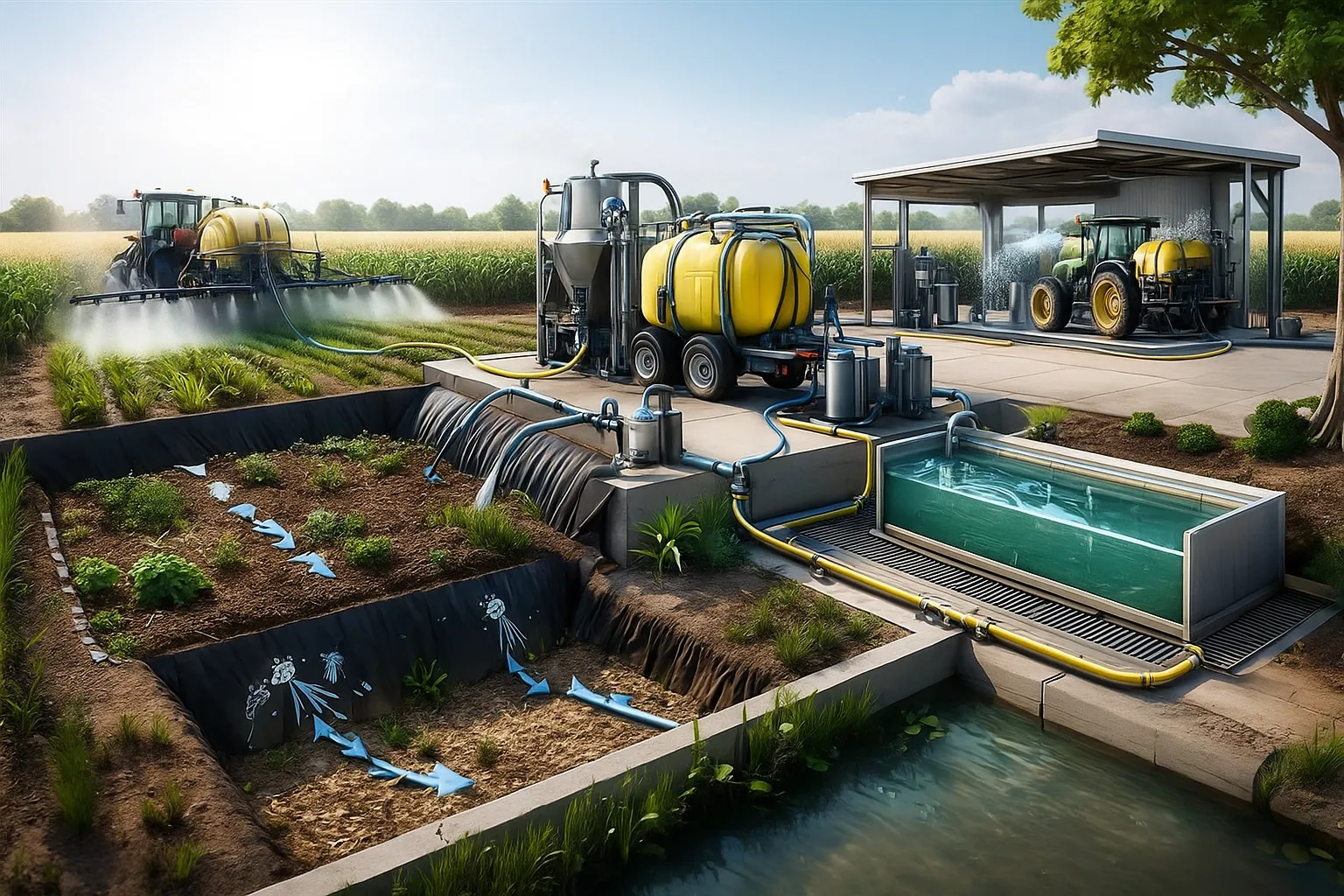
Volume of rinse water: a typical cleanup makes 100–200 L per rinsing session. Small farms (handheld sprayers) produce little waste. They tend to fit triple-rinse and field spray-out, or a small biobed. Large farms (multi-hundred-liter sprayers or repeated cleanings) make hundreds or thousands of liters. They favor engineered biobeds or treatment systems (nepis.epa.gov).
Pesticide properties matter: non‑persistent, water‑soluble actives (e.g., glyphosate, 2,4‑D) degrade quickly in biobeds or via reuse; persistent organics may pass slowly and require carbon/AOP polishing to meet discharge standards (mdpi.com; sciforschenonline.org).
Regulatory priority: any discharge must meet water-quality standards. Farms near watersheds, or under frequent inspection, may lean toward shipped service or on-farm treatment. If off-farm disposal is impractical, a lined biobed or a closed-loop pad may be mandatory.
Capital and operating cost: small farms with a tight budget find the cheapest route is reuse/flush plus triple-rinse, possibly with a DIY biobed using local materials. Medium farms usually choose a lined soak pad feeding a biobed sized by the 1 m³ per ~1,000 L/year rule. Some agencies subsidize biobeds at ~£66/m². Large farms or cooperatives justify commercial wash stations (settling tank plus carbon unit). These remove >95% of contaminants but cost tens of thousands of USD and generate hazardous residuals. One ICI system treats ~5,000 L per 2 hours at a price of tens of thousands USD when new (gov.uk). Systems in this tier usually meter coagulants via a coagulant feed and aid settling chemistry with a flocculant.
Space and maintenance: a biobed needs about 1 m² per 1,000 L/year of treatment. It needs a check every year (moisture, mixing), and the media is replaced every few years (sprayers101.com). Chemical systems take less space. However, they need skilled maintenance and safe handling of the used media.
Outcomes and trends: evidence shows biobeds are cost‑effective for many farms — often achieving ≥90% removal of test pesticides with low ongoing cost; investing in triple‑rinse and reuse yields 80–90% reduction immediately and avoids disposal fees (sprayers101.com; mdpi.com). High‑end treatment (AOP/GAC) offers near‑total decontamination but at high cost (nepis.epa.gov; sciforschenonline.org). Closed‑loop wash bays are increasingly popular in industrial/ag yards to minimize wastewater.
Decision examples: if the rinse volume is small (hand sprayer or minor use), triple-rinse plus spray-out on the treated field is typical. A small DIY biobed handles the occasional waste (ontario.ca). If the volume is moderate (small tractor sprayer), many farms install a lined wash pad with a collection tank and feed a 1–3 m³ biobed. This gives roughly 90–99% reduction at low cost when the liners, drainage and berms are correct (sprayers101.com; mdpi.com; sprayers101.com). If the volume is large (several big sprayers, or a cotton or tobacco farm), professional treatment or airtight closed-loop skids (flocculation + filtration + carbon) let the farm reuse the final water for cleaning. The budget must then include media and sludge disposal (nepis.epa.gov; sekitarsynergy.blogspot.com). Where water scarcity is a serious problem, reuse systems or continuous rinse come first, usually with a biobed to polish any backwash. Under strict scrutiny, farms usually combine triple-rinse or reuse with a treatment barrier for added compliance assurance.
Illustrative metrics and operating notes
Sprayer cleanup commonly generates ~150 L of rinse water with ~15,000 mg/L COD (chemical oxygen demand, a measure of oxidizable contaminants) and leaves 4–20 L of pesticide in lines and equipment without proper rinsing (nepis.epa.gov). A 1 m³ biobed treats ~1,000 L/season (rainfall included) and often removes 90–99% of most pesticides (sprayers101.com; sprayers101.com; mdpi.com). One carbon system changed filters after ~50,000 gal (~190,000 L), removing essentially all pesticide before reusing the water, with spent carbon managed as hazardous (sekitarsynergy.blogspot.com). Continuous rinsing reaches triple‑rinse residuals in about one‑third the time (realagriculture.com).
What most farms choose
Most Indonesian farms meet the regulations at the lowest cost with a biobed or soakbed and a strict rinsing protocol. Larger operations look at modular recycle and treatment units when disposal or reuse is not possible. In all cases, containers and soils are labeled or wrapped as B3 waste when full. A licensed B3 handler is engaged if disposal is needed. Records and worker training follow the label requirements and what the regulator expects.
Data are drawn from peer‑reviewed reviews and government reports on pesticide wastewater treatment (mdpi.com; sciforschenonline.org; nepis.epa.gov; nepis.epa.gov), industry guidance on biobeds (sprayers101.com; sprayers101.com), and regulatory/extension guidelines (EPA, Canadian, Indonesian) with measurable outcomes (gov.uk; ontario.ca; pedulipetani.id). All figures and efficacy estimates are backed by these sources. Additional schematics and system case notes come via sekitarsynergy.blogspot.com and wastechengineering.com.