

Article
Oil and gas wastewater has a nitrogen problem. The fix is a two‑zone bioreactor run like a tight ship.
Industry: Oil_and_Gas | Process: Wastewater_Treatment
Oil and gas wastewaters usually arrive with high ammonia (NH4+) and little easily biodegradable organics. The playbook now is biological. Put an aerobic nitrification zone up front and an anoxic denitrification zone downstream. Then manage the handoff so reliably that the biology barely notices the swings in plant load.
In practice, it is an activated‑sludge (or biofilm) reactor split into two (or more) compartments. The influent first sees an aerobic basin, dissolved oxygen (DO) about 2–4 mg/L, where autotrophic nitrifiers convert NH4+ → NO2− → NO3−. The stoichiometry is textbook: NH4+ + 2.0 O2 → NO3− + 2H+ + H2O, with about 4.57 mg of O2 consumed per mg NH4–N (nepis.epa.gov). That oxidation generates acidity, roughly 7.14 mg as CaCO3 per mg‑N (nepis.epa.gov). Therefore pH control is not optional.
The nitrified effluent is now rich in NO3−. It moves into an anoxic zone (DO ≪0.5 mg/L). Denitrifying heterotrophs use the nitrate as an electron acceptor and push it to N2 gas. Many oil/gas streams lack easy carbon. Therefore designers usually dose methanol or acetate to supply about 2.5–3.0 mg COD per mg NO3–N and target an M/N ratio around 3.0 (COD:N) for ≈95% nitrate removal (nepis.epa.gov) (lower ratios of ~2.6 suffice for partial removal, nepis.epa.gov). To make nitrate meet carbon, plants recirculate nitrified water into the anoxic tank at 1–3× the influent flow. This staged (usually step‑feed) design removes >90% of nitrogen as a rule.
Two‑zone biology and stoichiometry
Nitrifier biomass must be kept in the system. These cultures grow slowly. Therefore operators keep a high sludge age or use attached-growth carriers. Mixed-liquor MLVSS is usually kept in the thousands of mg/L, or fixed biofilm media are used, to protect the nitrification step.
On the denitrification side, the oxygen target is essentially zero. Any residual aeration in the anoxic tank cancels denitrification. Therefore facilities rely on strict DO separation between zones. Designers use DO controllers or differential aeration to hold that line and protect the aerobic/anoxic split.
Evidence from pilots and SBRs
One membrane-aerated reactor treating a high-nitrogen feed (370–390 mg/L COD, 500–600 mg/L total nitrogen) reached 82% total N removal, about 100 mg N/L·d, without external carbon addition (www.researchgate.net). In laboratory mobile-bed SBRs, nitrification efficiencies of 44–63% during acclimation with high COD/N have been reported (iwaponline.com). However, well-optimized systems usually drive effluent NH4–N into the low single digits.
It matters because the standards are strict. The Indonesian oil/gas wastewater standard KEP‑42/1996 needs effluent NH3‑N well below 10–15 mg/L. Therefore full nitrification/denitrification is needed. Systems such as MBBR, MABR and SBR have logged N‑removals above 80% on high‑strength waste (www.researchgate.net) (pubs.acs.org).
Pre‑treatment for oil and solids
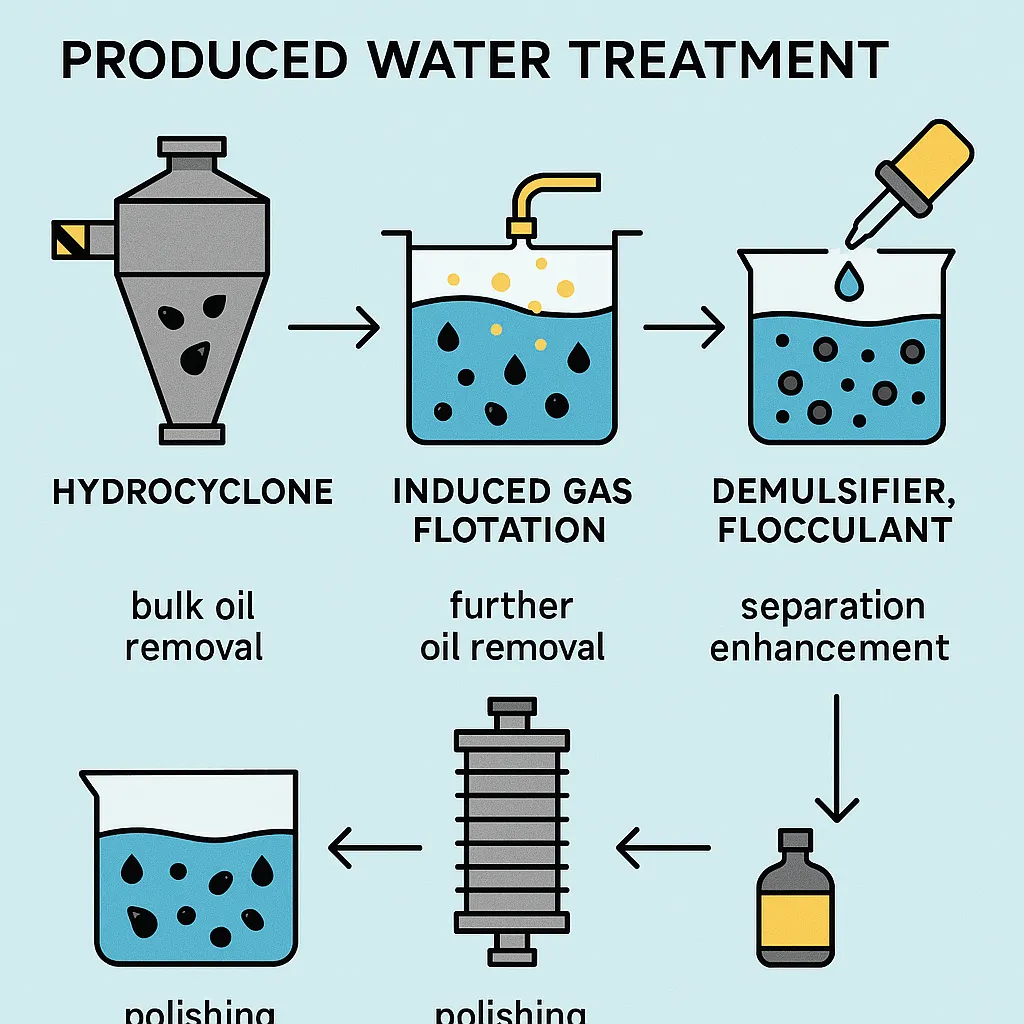
Oil, solvents, H2S, heavy metals and suspended solids can inhibit nitrification. Solids and oil droplets should be screened or floated off before biological treatment. Many facilities install automated headworks. For debris removal >1 mm, an automatic screen helps protect the biology upstream.
To address dispersed oil, dissolved‑air flotation is usually paired with primary systems. A compact DAF unit offers the kind of surface loading and separation that reduce inhibitory carryover into the aerobic zone. Integrated primary trains (screens, oil removal, and primary basins) are standard in waste‑water physical separation prior to nitrification/denitrification.
Control points: oxygen, pH/alkalinity, carbon
DO setpoints anchor performance. Design targets are usually ≥2 mg/L DO in the nitrification zone (nepis.epa.gov), with theoretical oxygen demand at 4.57 mg O2 per mg NH4–N plus a margin for biomass growth (nepis.epa.gov). Too low DO (<1 mg/L) will stall nitrification. In the anoxic tank, DO is ≈0 (usually <0.5 mg/L).
Nitrification uses up alkalinity, about 7.14 mg CaCO3 per mg-N nitrified (nepis.epa.gov). It can pull pH below 6.5 and then the nitrifiers stop working. Plants usually dose sodium bicarbonate or lime to keep pH at about 7–8. This raises the wastewater alkalinity to about 150–200 mg/L as CaCO3. Denitrification works the other way and reduces the acidity, because it consumes protons as NO3− is reduced. pH needs to be monitored continuously. If pH drops for no clear reason, nitrification is usually upset.
Carbon is the fuel for the denitrifiers. With low BOD feed, operators aim for an M/N ratio near 3:1. Methanol dosing around 3.0 mg COD per mg NO3–N removed is common, and gives about 90–95% nitrate conversion (nepis.epa.gov). If hydrocarbon-contaminated water raises the influent COD:N, the internal carbon can be enough. If not, methanol or acetate is added. Accurate metering helps. A dedicated dosing pump makes COD feed control simple, so NO3− does not break through.
Temperature, salinity, and biomass retention
Biological rates climb with temperature. Nitrifiers are active at about 15–35 °C. Below about 10 °C nitrification slows sharply. Above 40 °C they can be impaired. Warm wastewaters from gas treating usually nitrify easily. Denitrification also slows below about 10 °C. In tropical Indonesia (25–30 °C ambient), rates are usually favorable.
Salt matters too. Nitrifiers can tolerate high salinity. They remove NH4 completely even up to ~100 g NaCl/L, but they fail above ~125 g/L (www.liebertpub.com). Retention matters as much as resilience. Typical design SRTs are 10–15 days or more, so the nitrifiers are not washed out. A high mixed-liquor MLSS (3–5 g/L or more) stores biomass. Too much aeration or an SRT that is too short can bleach out nitrifiers, and then NH4 spikes.
Biofilm systems hold the slow growers in place. Moving-bed designs keep nitrifiers on carrier media. In practice, a moving bed bioreactor (MBBR) avoids the washout risk that low SRT suspended-growth plants have.
Hydraulics, mixing, and time in tank
Hydraulic discipline is non-negotiable. Both zones need good mixing (mechanical or via diffused air). Laminar paths or short-circuiting cut contact time and lower the rates. Typical aerobic hydraulic retention time (HRT) is 8–24 hours. Anoxic HRT is ~1–4 hours, adjusted to match nitrate conversion. Sludge wasting is tuned to keep the target SRT.
Internal nitrate recycles make the zones work together. Treated water from the aerobic nitrifier is usually recycled into the anoxic tank at 1–3× flow, so the nitrate meets the available carbon. Batch configurations, such as a sequence batch reactor (SBR), handle variable loads and keep the aerobic/anoxic sequencing described above.
Shock loads and toxicants
Ammonia shocks or toxins can stop nitrification. One study notes that ammonia shocks are the only crisis that disrupts nitrification (pubs.acs.org). Influent NH4+ must be equalized or partly removed, for example by an upstream stripper, to avoid spikes above 70–100 mg/L (pubs.acs.org). Denitrifiers are a bit tougher, but they will fail if oxygen gets in or if the carbon runs out.
Primary systems are the first line of defense against inhibitory carryover. If free oil persists, targeted oil removal can protect the nitrifiers downstream. It stops emulsions from entering the aerobic zone.
A refinery’s blueprint for reuse
In one refinery train, a pre-stripper removed about 50% of incoming NH4+ by air-stripping. The remaining ammonia was nitrified biologically in aeration basins and denitrified in anoxic zones. This let the plant reuse the water for cooling and saved “millions of cubic meters” of fresh water (pubs.acs.org). It shows how tight zone control turns compliance into conservation.
Measured outcomes and rates
Under optimized conditions, one pilot reactor reached nearly complete (≈82–90%) total N removal (www.researchgate.net). In practice, modern systems can usually bring effluent NH4–N below 1–3 mg/L. Removal rates of tens of mg N/L·d are typical. Industrial reactors with a heavy load can reach about 100 mg N/L·d transfer, as in the membrane‑aerated example above (www.researchgate.net).
Operating takeaway
The result depends on balancing nitrifier and denitrifier activity. This is done with DO control, pH and alkalinity dosing, and carbon dosing. To meet an effluent TN or NH4 limit, the reactor needs enough volume. It also needs real-time control of DO and pH, and enough carbon. These principles hold whether the plant is conventional activated sludge or biofilm-based. When these parameters are met, biological nitrification and denitrification is still a cost-effective and sustainable way to meet nitrogen limits in oil and gas wastewater.