

Article
Nickel plants recycle 95% of water: The chemistry can quietly tank flotation
Industry: Nickel_Mining | Process: Froth_Flotation
Modern nickel concentrators routinely recycle 80–95% of their process water to curb freshwater use (MDPI; SCIRP). The Kevitsa Ni–Cu–PGE plant in Finland deliberately pushes that to >95% (MDPI). But high recycle ratios make the circuit a closed chemistry loop: ore‑borne salts, metal ions and residual reagents accumulate, changing how froth flotation (a bubble‑based mineral separation method) actually performs.
Measured data from Kevitsa’s nickel circuit underline the point. Recycled water showed conductivity ≈2,300 µS/cm (∼1,400 mg/L total dissolved solids, TDS) and high alkalinity at pH ≈9.5 (MDPI). Dissolved Ni and Cu were on the order of 0.1–0.3 mg/L pre‑treatment (MDPI; MDPI), with silica fines ~5–7 mg/L (MDPI). Thickener overflow turbidity averaged ~96 NTU (nephelometric turbidity units) before treatment and fell to 20 NTU after dissolved‑air flotation (DAF, a microbubble clarification method) (MDPI).
Regulators are paying attention. In Indonesia, guidance highlights mine effluents with high total suspended solids and elevated nickel (Nikel.co.id). PermenLH No.9/2006 requires wastewater discharges not to exceed prescribed quality standards (Nawasis).
Contaminants and surface effects
Fines and clays, especially serpentine group silicates, produce hydrophilic “slime coatings” that block collector adsorption on sulfides. Serpentine (Mg₃Si₂O₅(OH)₄) often carries positive charge opposite to pentlandite, promoting such coatings and cutting Ni recovery (MDPI; MDPI).
Trace metal ions matter too. At flotation pH (~9–11), Fe²⁺, Ni²⁺ and Cu²⁺ precipitate as hydroxides, passivating sulfide surfaces and making them less hydrophobic, which lowers recovery (MDPI). Over time these metals can build to tens or hundreds of ppm; in Kevitsa water they were ~0.3 mg/L Ni and ~0.2 mg/L Cu (MDPI; MDPI).
Sulfur species add another drag. Sulfide oxidation generates thiosulfate and related ions that chemically compete with xanthate and carbonate collectors; lab and plant work show they “affect negatively on collector adsorption on sulphide minerals,” depressing pentlandite recovery (MDPI). Kevitsa’s recycled water held dissolved sulfur near ~250 mg/L (likely as thiosulfate) (MDPI), and its removal by treatment correlated with better flotation (MDPI; MDPI).
Hardness and alkalinity also go up in closed circuits as lime and carbonate build up. Calcium can precipitate or form films on surfaces. A review points to calcium’s complicating role in xanthate adsorption (ResearchGate). Residual organics from frothers and collectors can make the froth unstable and hurt separation efficiency. Industry reviews warn about this (MineralProcessing.co.za).
Measured impacts on recovery
Kevitsa’s own data are clear. Recycled nickel-circuit water made up less than 10% of total water addition. However, it had a negative impact on nickel recovery (MDPI). In bench tests, fresh make-up water was replaced with increasing amounts of thickener overflow. The Ni+Cu grade vs Ni recovery curves shifted to lower values every time (SCIRP).
Cleaning up the water reversed that trend. DAF-treated water was used instead of raw recycle. It gave a 2.6 percentage-point absolute gain in rougher-scavenger Ni recovery and a slight grade lift of +0.06% (MDPI). The economics were worked out. Even such a small improvement paid back the treatment investment (MDPI).
Water chemistry and reagents
Collectors such as xanthates (surface‑active chemicals that make mineral particles hydrophobic) need clean, oxidized mineral surfaces. Slime coatings and metal hydroxide films reduce active sites. Therefore the plant needs a higher dose. At Kevitsa, DAF‑treated water improved xanthate adsorption, which indicates better utilization (MDPI; MDPI). In practice, a contaminated circuit usually needs 10–50% more collector to keep recovery (industry reports indicate incremental dosing when recycle load is high, though exact values vary). High oxidation/deoxidation or dissolved oxygen swings can also change collector chemistry.
Frothers are alcohols and glycols that stabilize the bubble films. They are sensitive to residual organics. Recycled frother can cause “froth instability”, large bubbles or “knife-like” froth, and the defoamers used to fix it add cost (MineralProcessing.co.za). Depressants and pH modifiers such as lime concentrate inside closed loops. Kevitsa adjusted the DAF feed to pH 9 with Ca(OH)₂ and still had to manage circuit water that was already alkaline (MDPI).
Redox potential (usually measured as ORP) and ionic strength shift with recycle. Reviews note that seawater’s high ionic strength depresses some sulfide flotations (for example molybdenite). Therefore high‑salt recycle water can hinder gangue rejection and increase slime entrainment. “Flotation performance depends on water quality,” and high‑organic or saline waters can decrease recovery and cause froth issues (SCIRP; MineralProcessing.co.za).
Bleed streams and treatment trains
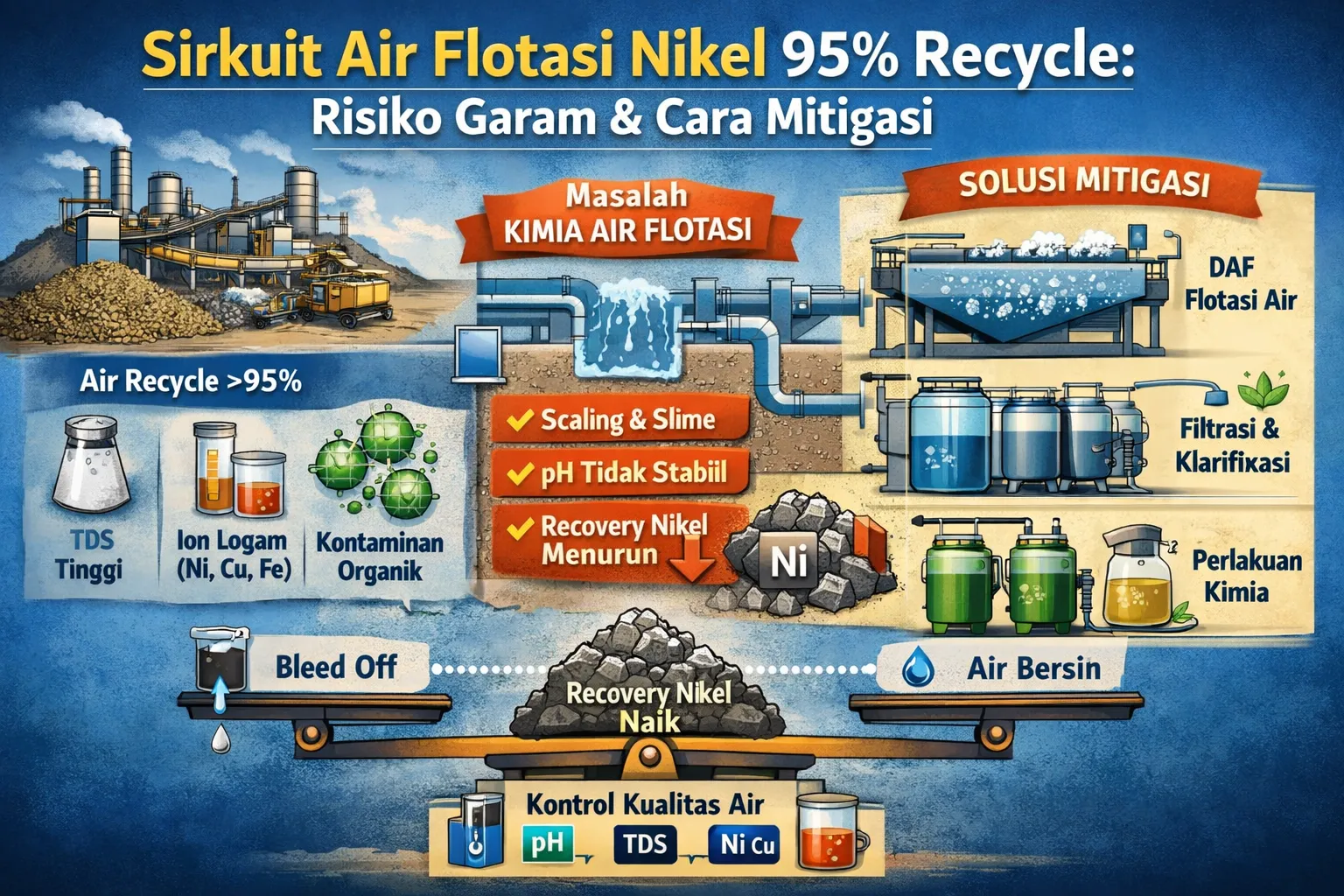
Most concentrators install a bleed (blowdown) stream to cap contaminant build-up. This stream pumps out a fraction of the recirculating water (usually 1–5% of total flow) from points like thickener overflow. Fresh make-up water balances the volume. Operators usually tie bleed rates to TDS, calcium, or COD thresholds. Mitigation advice includes “partial bleed‑off, filtration, [and] chemical polishing” (MineralProcessing.co.za).
Bleed water needs treatment. Solid–liquid separation is the first anchor: Kevitsa used dissolved‑air flotation to remove ultrafines, hydroxide flocs and entrained organics (with coagulant addition) (MDPI; MDPI). In trials, DAF removed >90% of suspended solids and cut dissolved metals roughly in half (MDPI). Plants deploying a DAF unit on even a minor bleed—Kevitsa treated <10% of flow—saw the 2.6‑point Ni recovery lift referenced above (MDPI). Others pair a clarifier with downstream filters or presses; cartridge polishing is common with a cartridge filter.
Chemical treatment complements separation. Lime or sulfide dosing at controlled pH precipitates dissolved Ni/Cu. Oxidants or coagulants bind organics ahead of flotation or DAF (MDPI). Plants usually meter these with a dosing pump. They choose chemistry such as coagulants based on jar testing.
For high‑recycle or arid sites, more treatment can be justified. Ultrafiltration removes colloids before polishing. Ion exchange scrubs metal ions. Reverse osmosis or electrodialysis reduce dissolved salts. Some studies even recommend vacuum membrane distillation or RO in high‑salt circuits (SCIRP). Practical options include ultrafiltration as pretreatment and modular RO/NF systems if salt control is important. Metal ion polishing can be targeted with ion exchange. Biological oxidation of residual organics is less common in minerals processing but can be applied to bleed streams. Where reuse quality is needed, plants consider membrane bioreactors.
Selective treatment strategies
Not every stream needs the same treatment. A recommended sequence is to analyze recirculating streams for Ca, thiosalts, sulfate, total carbon and TDS (a CanmetMINING‑style holistic assessment). Then run bench flotation with blends of fresh and recycle water to quantify impacts (SCIRP). Kevitsa targeted only nickel‑thickener overflow, a minor stream, rather than all water. This selective approach still delivered a payback (MDPI; SCIRP). In some concentrators, the entire tailings thickener overflow may need to go through a treatment plant if metal loading is high.
Reagent control under recycle
When thickener overflow is recycled without treatment, the nickel recovery curve shifts downward versus fresh‑water baselines (SCIRP). Collector dosage is usually raised 10–30% in high‑recycle water to compensate for scavenging by slimes and dissolved ions (no direct citation, but consistent with practice). Froth behavior can become erratic. Residual organics or low pH (high CO₂) may produce coarser, wetter froth. Trimming frother can crash froth, and sampling usually ties carryover dips to COD spikes. Stable, treated water avoids these swings.
Depressant and pH demands are also fluid. Nickel plants using lime or cyanide starch to depress pyrrhotite see consumption drift with recycle. If basin pH rises beyond design, lime usage increases. Operators frequently report rising lime consumption as recycle increases unless a bleed resets chemistry.
Overall, clean water reduces reagent costs and improves metal recovery. Kevitsa saw a higher Ni grade and recovery, and also a more stable froth response after water cleanup (MDPI; MDPI). If water contaminants are ignored, recovery and grade go down and reagent bills go up. Benchmarks exist. Cutting Ca in flotation water from 200 mg/L to 50 mg/L improved molybdenite recovery by ~5% at Taiwan’s Nanzih Copper Mines. This is an analogy for nickel circuits (SCIRP).
Regulatory alignment in Indonesia
Indonesian plants face clear regulatory lines: effluents often show high TSS and elevated Ni, and discharges must meet PermenLH No.9/2006 quality standards (Nikel.co.id; Nawasis). In context, Indonesian standards typically limit Ni in effluent to sub‑ppm levels; even the ~0.3 mg/L range seen in Kevitsa’s raw recycle would be non‑compliant unless treated (MDPI; MDPI).
Operating recommendations and KPIs
Monitoring: Track pH, conductivity/TDS, calcium, Ni, Cu, COD/TOC and turbidity across recirculating streams. Sample across a full year to capture seasonal variability (SCIRP).
Bleed control: Tie the start of bleed to analytical limits. For example, start bleed when TDS or dissolved Ni approaches 50–80% of the discharge limits. This prevents excursions and makes compliance simpler (MineralProcessing.co.za).
Treatment: Use a dedicated plant—coagulation and a DAF or a clarifier with downstream polishing—to remove residual Ni/Cu and solids before discharge or reinjection (Nikel.co.id; Nawasis). Where reuse and salt control are goals, evaluate RO/NF trains after UF pretreatment.
Reagent optimization: Re‑tune the depressant and collector programs as the water chemistry shifts. Run periodic in‑house flotation on fresh and recycle blends to recalibrate the doses (SCIRP).
KPI balance: Above ~95% recycle, Kevitsa saw that even a ~10% recycled fraction (cycles‑of‑concentration ~20×) began to hurt Ni performance. Indonesian plants should test whether pushing recycle above ~90% causes a measurable recovery loss. They should also consider diverting that fraction to treatment (MDPI).
The through‑line is consistent: maximize volume recycle, but actively bleed and treat to control chemistry. Data‑driven thresholds for ions and organics, plus targeted clean‑up, stabilized Kevitsa’s flotation response—and similar ~2–3 percentage‑point Ni recovery gains can offset the capex/opex of treatment (MDPI; MDPI). That approach also aligns with Indonesia’s discharge standards and enforcement trajectory (Nikel.co.id; Nawasis).