

Article
Inside the woodyard’s first bottleneck: drum vs ring debarkers, the real cost of bark, and why maintenance rules
Modern woodyards hinge on how fast and cleanly logs shed bark. The choice between drum debarkers and rotary (ring/roller) designs—and the rigor of maintenance—decides yield, energy, and uptime.
Industry: Pulp_and_Paper | Process: Woodyard_&_Chip_Preparation
A single upstream hiccup can idle an entire pulp mill. At a 2400 tpd (tons per day) operation, about 100 t/h (tons per hour), each lost hour costs roughly $45,000 in contribution margin (eucalyptus.com.br). Therefore mills watch the woodyard’s workhorse closely: the debarker.
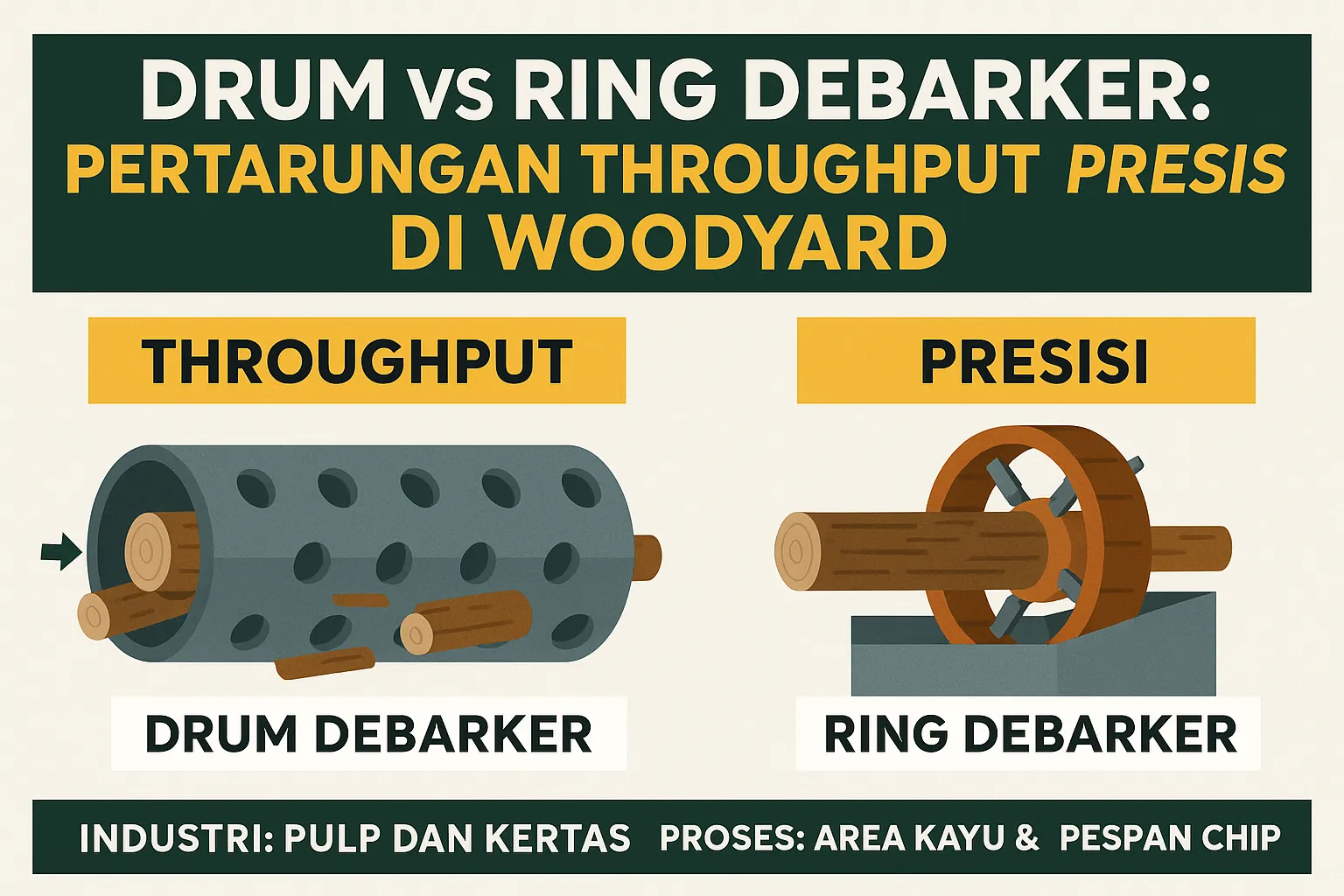
Woodyards use robust debarking machines to strip bark before chipping (Acrowood) (Acrowood). Two families dominate: drum debarkers—the long, inclined cylinders where logs tumble and rub—and rotary units, often called ring or roller debarkers, that use a stationary bin and rotating shafts or rollers fitted with tooling.
Debarking mechanisms and designs
In a drum debarker, logs continuously rotate and rub against each other and the drum interior inside a large inclined cylinder, shedding bark via abrasion and log-on-log friction (Acrowood) (Acrowood). Drums handle very high volumes with straight, uniform logs and can be built with rubber-tyre support or hydrostatically supported shells (pressurized oil film so there is no mechanical contact) to support the large shell (Valmet) (Valmet).
Rotary debarkers (ring or roller types) use a stationary bin where multiple rotating shafts or rollers, fitted with knives/flails, shear bark while logs tumble and scrub each other (Acrowood) (Acrowood) (Acrowood). For a given capacity, rotary units tend to have a smaller footprint and consume less energy than drums (Acrowood), and they excel at tough or frozen-bark species—including crooked logs and stringy-bark hardwoods like eucalyptus or acacia common in Indonesia (Acrowood) (ANDRITZ).
Other designs exist for specific contexts. Chain/flail debarkers are common as portable, whole-tree processors in the forest. Compression/cradle debarkers target particular log types (Wood and Fiber Science (WFS)).
Throughput, species, and selection
Drum debarkers can process broad log-size ranges at the same time. They are valued for sheer throughput (Acrowood). Industry reports cite drum lines of tens of meters that reach roughly 150–200 m³/h (cubic meters per hour) of debarked wood (IEM Group). Rotary installations are modular. A 12-rotor line with about 30 m of debarking length handled ≈425 m³/h (≈450 tons/h) of hardwood with just ~0.3% residual bark (IEM Group).
Vendors emphasize optimized drives and tooling—belt-driven or VFD-controlled (variable frequency drive) systems—to push capacity and cleanliness (IEM Group) (ANDRITZ). Valmet explicitly markets debarking lines that combine “high capacity…with optimal bark removal and minimum wood loss” (Valmet). In practice, system choice hinges on species (softwood versus stringy-bark hardwoods), log geometry, climate (freeze–thaw impacts on bark), space, and capital (Acrowood) (ANDRITZ).
Debarking efficiency and wood loss
High debarking efficiency means nearly all bark is removed. Wood loss is the unwanted removal of wood fiber with the bark. Industry audits show that pulp mills usually waste ~1–4% of wood volume during debarking. For a single line, these losses can add up to roughly €1 million per year in forgone profit (Pulp&PaperNews) (Teknosavo).
Optimization can claw that back: Teknosavo’s WoodSmart debarking controls report reducing wood loss by an average of 1–4% through precise log feed and debarking settings (Teknosavo) (Pulp&PaperNews). Modern rotary lines have demonstrated clean logs with bark remaining of 0.3%—effectively 99.7% bark removal (IEM Group), and suppliers such as ANDRITZ state that their rotary systems yield less wood loss than drum debarkers (ANDRITZ).
Wood loss is also shaped by the mechanism: drum debarkers rely primarily on log-on-log friction—an inherently abrasive process—while rotary/roller designs use targeted tooling to shear bark (Acrowood). Vendors argue rotary systems produce less breakage and put much lower energy into the logs (ANDRITZ). On crooked or knotted logs, drums can debark less consistently (Acrowood).
Chemical demand and pulp quality
Less bark left on the chips helps the downstream process. Bark carries a lot of ash and extractives. These soak up cooking chemicals and degrade the pulp. In a controlled study of hardwood chips, more bark raised alkali demand sharply. Soda need rose from 12.8 kg/t at 0% bark to 312 kg/t at 100% bark. The reject rate climbed from 0.7% to 21.1%. Tensile, burst and tear strengths dropped about 58–68% at 100% bark (Nordic Pulp & Paper Research Journal) (Nordic Pulp & Paper Research Journal). Even a small bark fraction raises chemical use and lowers yield (Nordic Pulp & Paper Research Journal).
The implication is straightforward: pushing debarking efficiency above 95–99% directly improves yield, trims cooking and bleaching cost, and stabilizes quality—benefits that compound with throughput and uptime (Pulp&PaperNews) (Nordic Pulp & Paper Research Journal).
Maintenance practices and wear management
The debarker is an upstream bottleneck. Therefore any downtime stops chip production at once. At 2400 tpd, that is ≈100 t of pulp output lost per hour (eucalyptus.com.br). Debarkers have “lots of moving parts”. When something happens, “everything grinds to a halt”, as one service firm notes (Southern Field-EEC). Proactive upkeep is not optional.
Lubrication and routine inspection come first. Following the OEM lubrication schedule for feed gears, bearings, and actuators is vital (Southern Field-EEC) (WoodBUSINESS.ca). Maintenance manuals call for specific greasing points and intervals: for example, Nicholson specifies daily checks of knife-arm lubrication lines and weekly to monthly oiling of pins and bearings (WoodBUSINESS.ca). Techs also inspect and tighten lube fittings each service round (WoodBUSINESS.ca).
Shift-based visual checks are standard. Knife tips and arms get torque checks about every 8 hours. The ring and bearings get them every 40 hours. Any unusual noise or vibration triggers further inspection. This is the “listen for vibrations” approach that veteran millwrights use (WoodBUSINESS.ca) (WoodBUSINESS.ca).
Wear parts—knife plates, tooth inserts/spikes, and feed roll surfaces—must be replaced before failure. Under severe conditions, uncoated ring-debarker knife arms lasted about three days; applying a hard wear overlay extended service life to roughly three months (Paper&Wood). Checklists typically include feed inserts (for log grip) and gear backlash measurement (WoodBUSINESS.ca), along with bearing play, belt tensions, and hydraulic/oil system health (WoodBUSINESS.ca) (WoodBUSINESS.ca).
In the longer term, OEMs usually recommend a full inspection by factory-trained technicians every six months, or more frequently (WoodBUSINESS.ca). This service realigns the tool circle so the pressure is even at all knife arms (WoodBUSINESS.ca). It also overhauls the drive trains as needed. Housekeeping matters. Bark buildup can jam mechanisms, so conveyors and ring-cleaners must be cleared routinely (WoodBUSINESS.ca). Where optical or laser monitoring is installed, it flags bark content that is out of spec. Crews then check and adjust the tongue seals or rotor settings.
The payoff is uptime. ANDRITZ, for one, highlights the RotaBarker’s “outstanding uptime” and fully debarked logs even in toughest conditions (ANDRITZ). The inverse is costly: a single worn bearing or blocked nozzle can trigger an unplanned stop. Given modern lines run in the hundreds of tons per hour, nearly every maintenance action is justified to avoid unscheduled downtime (eucalyptus.com.br) (Pulp&PaperNews).
System features highlighted by suppliers
Manufacturers combine mechanical choices with process control. Valmet outlines options from rubber-tyre to hydrostatic drum support—where “there is no mechanical contact”—and markets debarking lines as “high capacity…with optimal bark removal and minimum wood loss” (Valmet) (Valmet) (Valmet). ANDRITZ’s RotaBarker literature emphasizes flexible tooling and benefits including less wood loss and high uptime (ANDRITZ) (ANDRITZ).
Drum debarkers remain the benchmark for raw throughput (Acrowood), with installed lines clocking roughly 150–200 m³/h (IEM Group). Rotary systems scale via modular rotors to hundreds of cubic meters per hour and have documented bark remaining of 0.3% in hardwood service (IEM Group).
(Citations legend from the underlying research: the original paper cites each source inline by bracketed reference, with line numbers from the source.)
Sources (as cited and linked)
Chahal AS, Ciolkosz D (2019). A Review of Wood–Bark Adhesion: Methods and Mechanics of Debarking for Woody Biomass. Wood and Fiber Science, 51(3): 275–290. WFS Journal (wfs.swst.org). Tripathi SK, Alam I, Bhardwaj NK (2020). Effect of bark content in mixed hardwood chips on pulp and papermaking properties. Nordic Pulp & Paper Research Journal 35(3): 325–331 (degruyter.com) (degruyter.com). ANDRITZ Group (2024). RotaBarker rotary debarker system (product description) (andritz.com) (andritz.com). Valmet Ltd. Debarking (wood handling) (valmet.com) (valmet.com) (valmet.com). IEM Group (2023). Debarker projects (case studies) (iem.ca) (iem.ca). Castolin Eutectic (May 2023). Sustainable wear-resistant solutions cut downtime for pulp and paper plant. Paper&Wood Online (paperandwood.com). Southern Field-EEC (2020). 3 Tips for Better Debarker Maintenance (southernfield.com) (southernfield.com). Snook A (2016). Debarker maintenance. WoodBUSINESS.ca (woodbusiness.ca) (woodbusiness.ca) (woodbusiness.ca) (woodbusiness.ca) (woodbusiness.ca) (woodbusiness.ca) (woodbusiness.ca) (woodbusiness.ca). Matthis S (2016). Pulp mills are losing wood up to 4 percent/year. Pulp&PaperNews (pulpapernews.com). Teknosavo Ltd. Optimization Services: Reduced wood loss, higher quality. WoodSmart technology (teknosavo.fi). Acrowood Corp. (2025). Drum vs. Rotary: Choosing the Right Heavy-Duty Industrial Debarker (acrowood.com) (acrowood.com) (acrowood.com) (acrowood.com) (acrowood.com) (acrowood.com).