

Article
Brewery wastewater is getting pricier — and riskier. The real cost of owning a plant versus buying water-as-a-service
Industry: Brewery | Process: Wastewater_Treatment
Brewing uses a lot of water. Asahi puts the global average at about 4.5 hectoliters (hl) of water per 1 hl of beer produced (pall.com). Much of that water becomes high‑strength wastewater. Typical brewery effluent contains 3,000–10,000 mg/L biochemical oxygen demand (BOD, a measure of organic load). That is up to about 30× residential sewage. It also contains up to ~3,000 mg/L total suspended solids (TSS) (aquacycl.com).
The surge in craft breweries — from ~4,600 in 2015 to 8,275 in 2019 — has only tightened the screws on local sewers (aquacycl.com). In Indonesia, new KLHK rules (2025) require online real‑time monitoring and tougher effluent standards for food and beverage plants (greenlab.co.id) (greenlab.co.id). Non‑compliance isn’t cheap: administrative fines, permit suspension, or even revocation are spelled out (greenlab.co.id).
Before any further steps, many plants start with solids management. They use primary equipment such as screens and oil removal systems to protect the processes downstream.
Onsite ownership: capital, kit, and control
An in‑plant wastewater treatment plant (WWTP) needs a lot of capital. A brewery must pay for engineering, construction and equipment, from anaerobic and aerobic stages to membranes and dissolved air flotation (DAF). Major breweries including Sierra Nevada and Red Hook invested in anaerobic digestion systems (researchgate.net). Even modest flows (hundreds of m³/day) can run into the millions. Industry data suggests municipal‑scale WWTPs can cost on the order of $1–3+ million per MGD (million gallons per day, ≈4,000 m³/day) of capacity.
Primary clarification is still common in brewery layouts. It usually uses modern clarifier units that steady the hydraulics before biological treatment.
Operating costs sit on the brewery’s ledger: labor, electricity, chemicals, sludge disposal, maintenance and admin. One U.S. guide estimated wastewater, including pumping and oxygenation, at 10–30% of a brewery’s electricity costs (scribd.com). Sludge hauling or disposal adds several USD per m³ treated. Some microbreweries have spent “tens of thousands of dollars per month” on off‑site hauling (aquacycl.com).
Biological stages do most of the work to cut the high-strength load. Plants use anaerobic and aerobic digestion to lower BOD before discharge or reuse.
Return on investment can be good. In a study of three craft breweries, anaerobic treatment cut water and disposal costs by up to about 50%. The study called this “a substantial amount… even when taking into account the immense cost of purchasing the equipment” (researchgate.net). Owning also gives full control of discharge quality and of any resource value, such as biogas or nutrient recovery. The other side is that the brewery carries the risk of performance, maintenance and future expansion.
Integrated membrane systems are used more and more where reuse is a goal. Compact membrane bioreactors (MBR) combine biological treatment and membrane filtration in a single train.
In Indonesia, large beverage factories already run WWTPs to meet Permen‑LHK standards. The 2025 rule changes will push more breweries to invest in treatment that works (greenlab.co.id). Costs are similar or higher in IDR terms. A $1M plant is about 15 billion IDR. Small breweries usually cannot invest that much, so they turn to hauling or contracting. Firms may get green financing or tax incentives, but this varies by region. Any downtime or non‑compliance can mean lost production or fines (for example IDR tens of millions for serious violations).
Consumables and dosing matter in day-to-day operations, from coagulants in primary treatment to precise chemical feeding with a dosing pump that stabilizes pH and helps settling.
Some facilities choose modular packages to limit civil works. They use packaged treatment units that can be expanded as production grows.
Third‑party DBO/WaaS: outsourcing risk for a tariff
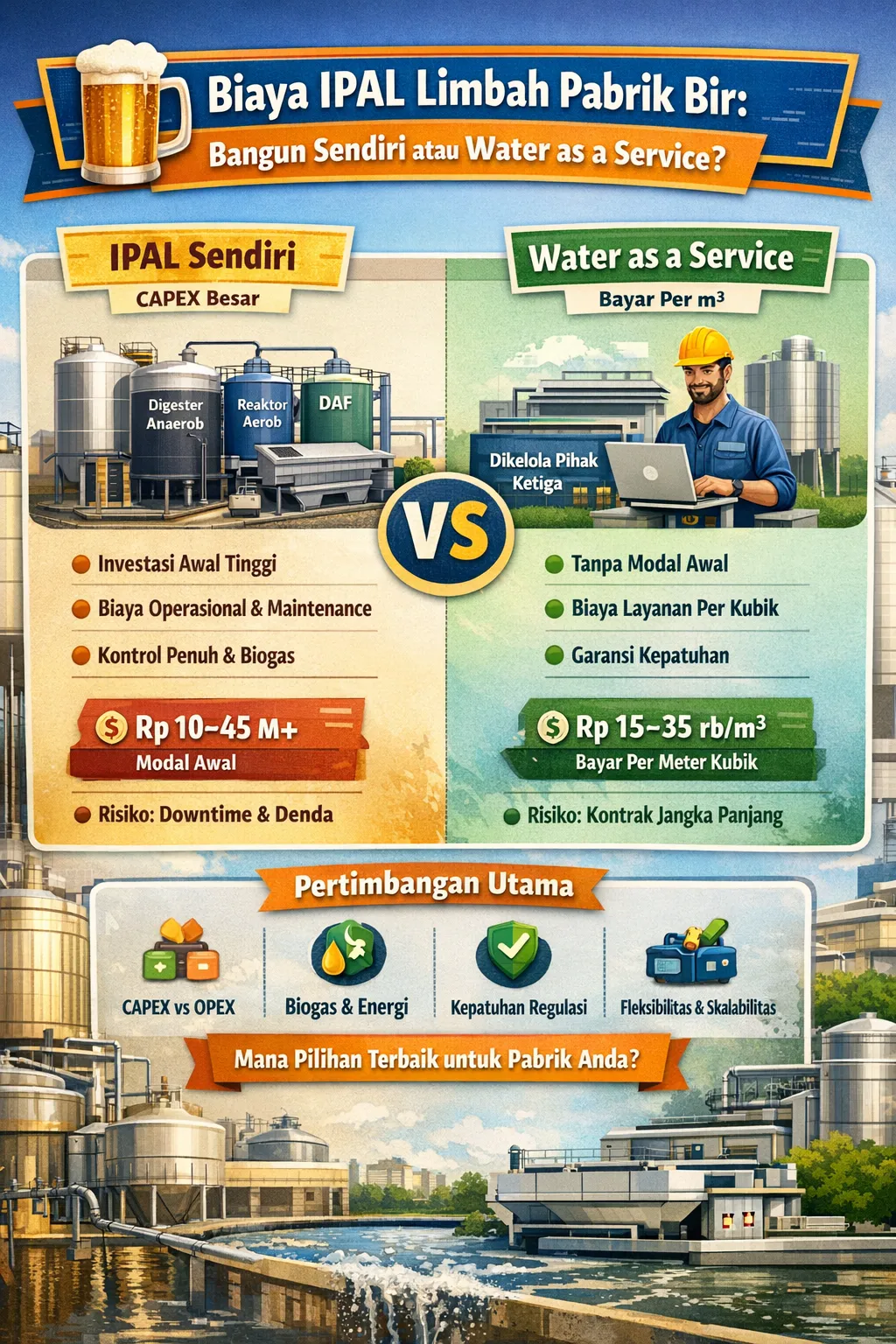
Under design-build-operate (DBO) and water-as-a-service (WaaS) models, a specialised water company designs and builds the plant. It usually also owns and operates it. The brewery pays a service fee, either fixed monthly, per gallon, or a hybrid (sometimes called an “Inframergization” contract). Cambrian Innovation’s “Water-Energy Purchase Agreement” (WEPA) “eliminates up-front capital costs for customers, allowing them to pay for performance on a per-gallon basis” (watertechonline.com). Providers like Seven Seas Water highlight WaaS deals that “guarantee capacity, quality, and cost” so clients can “focus on their core mission” (sevenseaswater.com).
Service providers put up their own capital, usually private equity or bonds (sevenseaswater.com), and recover it over 10-15 years through tariffs. In practice, fees can cover treatment capacity, maintenance and downtime guarantees. New business models let plants add capacity without bond issuance. “The WEPA can also facilitate [financing] without disrupting ongoing plant operations” (watertechonline.com).
Outsourced operation shifts technical risk. Operators run the plant 24/7, usually with SCADA (supervisory control and data acquisition) monitoring and predictive maintenance, and guarantee discharge quality. A leading UK brewery producing 60 million pints/year fully outsourced its WWTP to Nijhuis-Saur. Nijhuis-Saur provides plant operation, out-of-hours callout, maintenance, technical support and process monitoring (nijhuisindustries.com).
Third-party plants still use familiar unit processes. Skid-mounted separators are still common, and DAF features prominently in many DBO designs, much like a standalone DAF system at a site the owner operates.
Results can be measured. The Florida Brewery (34 million gal/yr wastewater) replaced tanker disposal with an on-site membrane bioreactor under Cambrian’s DBO contract. The project “eliminate[d] high-strength wastewater trucking,” cut CO₂ emissions by ~254 metric tons/year, and gave “significant annual cost savings” (cambrianinnovation.com).
Some providers use new biology. Aquacycl offers an MFC-based (microbial fuel cell) service contract, “BETT,” with “no capital expenditures.” Customers pay a service fee for guaranteed treatment (aquacycl.com).
Ancillary scope is usually bundled into the tariff, from spare parts to monitoring hardware. An owner would source the same items under wastewater ancillary packages.
Cost comparison: capex, opex, and payback
Owning a plant needs a large upfront outlay. One Belgian brewer’s WWTP project led by Veolia (2025) involved a multi-million € investment in anaerobes, clarifiers, and reuse systems (veoliawatertech.com). By contrast, WaaS may involve minimal or no upfront payment (beyond sign-up fees). As WaterTechOnline put it: “DBO/WaaS eliminates upfront capital costs… allowing them to pay for performance on a per-gallon basis” (watertechonline.com).
Operationally, third‑party fees often scale with flow or load. If a brewery reduces wastewater volume through conservation or reuse, it pays less. In some models, the technology owner may capture the biogas value under the service agreement, depending on contract terms (researchgate.net) (cambrianinnovation.com).
Benchmarks help. U.S. breweries producing 100k–1M bbl/yr usually spent $1.2–$4.2 per barrel on wastewater (sewer base charges, BOD/TSS surcharges, energy, etc.), or roughly $10–$35 per m³ of wastewater (scribd.com). The Cal Poly study found costs decreased by up to about 50% after installing anaerobic digesters (researchgate.net). If a brewery paid $30/m³ in surcharges, a 50% cut saves $15/m³. That is enough to service debt on equipment for many projects.
Where reuse is part of the cost case, treatment trains may add membrane and disinfection steps. Pretreatment with ultrafiltration (UF) is a common bridge to polishing and final disinfection with ultraviolet (UV) systems.
Technology menu: unit processes and modules
DAF remains a go‑to for suspended solids and fats/solids control. Modular offerings like a plant‑scale DAF unit mirror this, and the unit can be slotted between equalization and biology.
Alternative biological configurations can handle variable loads. One example is moving bed bioreactors (MBBR), which use carriers to grow biofilm and smooth out shock loads.
Seeding and nutrients are standard tools in start‑up and upset recovery. They are supported by microbial and nutrient consumables that stabilize biomass growth.
Trends and regulatory outlook
Industry trends favor outsourcing in settings with tight capital or rapid expansion. Since 2015, Cambrian’s WEPA has enabled food and beverage plants to add capacity without capital outlay (watertechonline.com). “SaaS‑like” WaaS models are growing globally; providers argue they avoid lengthy financing and deliver guaranteed performance (sevenseaswater.com) (watertechonline.com).
In water‑scarce regions, breweries increasingly pursue reuse and even zero‑liquid discharge. Specialized third parties usually implement this. In Indonesia, with real‑time monitoring and tightened standards, breweries may favor WaaS or PPP to meet obligations with minimal risk (greenlab.co.id).
Nutrient control is also tightening in many jurisdictions. Therefore staged designs with dedicated nutrient removal steps are more common in brewery WWTPs.
Decision framework for brewers and controllers
CapEx vs. OpEx: Owning the WWTP means large upfront spending, but the cost per unit is lower long term. Partnering shifts this to pay-per-use. As a rule, “DBO/WaaS eliminates upfront capital costs… allowing them to pay for performance on a per-gallon basis” (watertechonline.com). Controllers should compare the Net Present Value. For example, amortizing a $1–3M plant at ~5–10% interest against paying $X/m³ for services.
Risk and compliance: In‑house plants deliver control but require expertise and diligence. Service providers assume compliance risk and use advanced monitoring. Given Indonesia’s online‑monitoring mandate and strict sanctions, the warranty of compliance under a service contract can be valuable (greenlab.co.id) (greenlab.co.id).
Cost savings and sustainability: Effective treatment can turn wastewater into value. Whether generating biogas on‑site or avoiding haulage, savings in the tens of percent are possible (researchgate.net) (cambrianinnovation.com). Newer technologies like microbial fuel cells are available under service contracts (aquacycl.com).
Scalability: A service from a third party is usually modular and can be scaled up. A service contract can guarantee performance without large installation costs, and it can be scaled to meet changing production demands (aquacycl.com).
Bottom line: For breweries with limited capital or rapid expansion plans, DBO/WaaS offers predictable cash flows and regulatory compliance with minimal internal burden (watertechonline.com) (sevenseaswater.com). Established breweries with stable cash and access to incentives may prefer to build and own — especially if they can capture energy credits or grants (researchgate.net) (cambrianinnovation.com). In all cases, lifecycle costs and the risk of downtime or fines should be explicitly priced.
Sources and methodology
Authoritative industry reports and case studies (Master Brewers Assoc., WaterTech, Veolia, Cambrian, etc.) and Indonesian regulatory updates were used. Key data sources include brewery waste management case studies (researchgate.net) (cambrianinnovation.com), technology providers’ technical briefs (aquacycl.com) (watertechonline.com) (sevenseaswater.com), and official environmental news (greenlab.co.id) (greenlab.co.id). All figures and trends are supported by the cited references.