

Article
Textile mills are boiling away profits. Heat recovery and low‑temperature chemistry are changing that.
Industry: Textile | Process: Scouring_&_Bleaching
In cotton finishing, scouring and peroxide bleaching have long meant near-boiling baths and near-boiling fuel bills. Scouring is an alkaline boiling step that strips waxes and pectins. Conventional H₂O₂ bleaching runs at ∼98 °C for 30–60 minutes (pmc.ncbi.nlm.nih.gov). One lab scouring case used 1.5% NaOH at 100 °C for 45 minutes (pmc.ncbi.nlm.nih.gov).
Industry wastes much of that heat. About a third of all energy goes to industry and roughly half is lost as heat (www.mdpi.com). In practice, a typical continuous scouring/bleaching vat discharges wastewater at ~40–60 °C, while the fresh water makeup is near ambient. Without recovery, the energy in that hot effluent is lost.
Energy intensity of hot‑liquor finishing
Textile finishing’s large hot‑liquor volumes make it a standout energy sink. The combination of long dwell times (tens of minutes) and near‑boiling temperatures (95–100 °C) drives steam demand in scouring/bleaching, especially with hydrogen peroxide (H₂O₂) systems at ∼98 °C for 30–60 minutes (pmc.ncbi.nlm.nih.gov).
Waste‑heat recovery systems
Routing hot wastewater through heat exchangers to preheat incoming water now gives large returns. One analysis used a heat exchanger plus a thermal storage tank and cut process heating cost by ~63% (www.researchgate.net). In Benninger’s “zero-discharge” concepts, ultrafiltration/RO reuse of bleaching liquor reached 80–90% and captured up to 70% of its heat (www.fibre2fashion.com). In mills, that means preheating fresh water and sharply cutting steam.
These reuse loops usually use ultrafiltration modules. In this case, systems like ultrafiltration work as pretreatment before high‑pressure recovery. This lets the liquor be recirculated, with the cited 80–90% reuse and up to 70% heat capture (www.fibre2fashion.com).
Effluent‑to‑water preheat and exhaust exchange
Preheating makeup water using hot scouring/bleach effluent via plate or shell‑and‑tube exchangers can recover nearly three‑quarters of the effluent’s energy. One example: lifting fresh water from ~25 °C to ~60 °C recovered ~70% of the effluent heat (www.fibre2fashion.com).
Hot exhaust streams are also recoverable. Heat‑pipe exchangers on fabric heat‑setting machines have been reported to recapture >90% of lost heat to supply process air or boiler combustion air (www.vrcoolertech.com; www.vrcoolertech.com).
Heat pumps and storage integration
Where waste heat is low-grade (warm rinse water at about 30–50 °C), industrial heat pumps can upgrade it. A pilot absorption heat pump running on engine exhaust gave 34.4 kW of cooling from 16 kW of waste heat (0.96 COP, coefficient of performance) (www.mdpi.com). If you couple exchangers with heated-water storage, the batch flows balance out. In one modeled dyeing case, a storage-integrated system cut energy by 63% with zero drainage losses (www.researchgate.net).
At mill scale, the savings add up. Exhaust-duct boilers and economizers on onsite power generators eliminated about 131,772 MWh/year of fuel use and about 52,700 tCO₂ (www.mdpi.com). About 80% of the engines’ fuel energy can be recovered with waste-heat recovery systems (www.mdpi.com). One estimate puts the potential for textile waste-heat recovery at about 1.02×10^14 kWh/year. That saves about $1.35 billion and about 24.8 MtCO₂ (www.researchgate.net).
Realistic steam reductions in scouring/bleaching
Across studies, heat recovery saves “tens of percent.” For bleaching and scouring, ~60–70% reduced steam usage is realistic (www.fibre2fashion.com; www.researchgate.net), especially when preheating lifts incoming water from ~25 °C to ~60 °C by exchanging with hot effluent (www.fibre2fashion.com).
Where water reuse comes with heat capture, membrane trains similar to membrane systems can be paired with exchangers. Then the liquor volume is recycled along with the thermal energy. This fits the Benninger approach (80–90% water recycling, up to 70% heat recovery) (www.fibre2fashion.com).
Low‑temperature scouring and bleaching agents
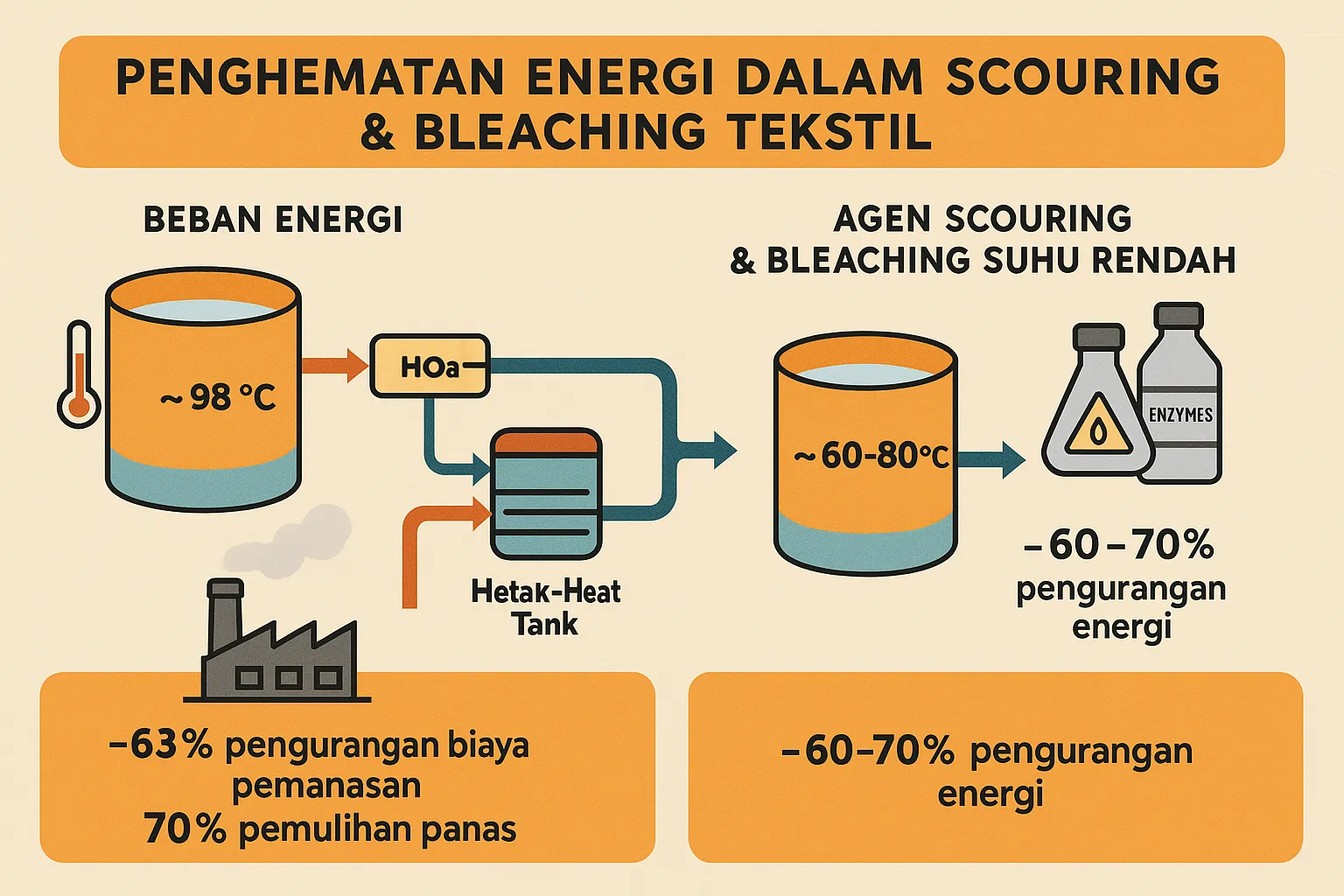
Changing the chemistry cuts temperatures. Enzymatic scouring (using pectinases or lipases) runs at about 50–60 °C and neutral to mild pH, not a 100 °C caustic boil. One study used a pectate‑lyase enzyme at 55 °C for 60 minutes (pH 5–5.5, 0.5–0.8% o.w.f., on weight of fabric). It reached essentially complete hydrophilicity (wetting time about 4.9 s) with only 3–4% mass loss. Enzymatic scouring “uses reduced amounts of water, chemicals, and power” under milder conditions than NaOH (pmc.ncbi.nlm.nih.gov, pmc.ncbi.nlm.nih.gov).
On bleaching, peroxide activators and alternative oxidants lower the heat you need. Adding 0.9 g/L glycerol triacetate plus 1.0 g/L peracetic acid (PAA) to H₂O₂ gave a whiteness index (Berger W) of 61.1 at just 80 °C for 30 minutes. That is about 97% of the conventional 98 °C result (pmc.ncbi.nlm.nih.gov). PAA at 65 °C on cotton or bamboo gave “strong whitening” comparable to 90 °C H₂O₂ with much less fiber damage (www.researchgate.net). UVA/UV‑assisted systems even run at room temperature. One study reported about 70% less energy than steam bleaching at 98 °C (pmc.ncbi.nlm.nih.gov). Other low‑temperature methods (ozone, ultrasound, microwaves) are also under exploration.
Some mills combine steps in one bath (enzyme plus peroxide, usually with mild alkali). They report 50–70% energy savings because they use fewer baths and a lower peak temperature (pmc.ncbi.nlm.nih.gov). Precision feed hardware such as a dosing pump helps control peroxide activators (for example triacetin, TAED) or PAA additions at reduced temperatures. This supports the documented outcomes (for example 80 °C whiteness index 61.1, ~97% of 98 °C) (pmc.ncbi.nlm.nih.gov).
Performance trade‑offs and savings range
Each low‑temperature method can give slightly lower absolute whiteness. They are usually aimed at light colors or at targets close to conventional performance (for example ~97% white). However, the energy gains are material. One UVA route cut energy by ~70% (pmc.ncbi.nlm.nih.gov), and an optimized low‑temperature bleach reached near‑conventional whiteness with reduced energy (pmc.ncbi.nlm.nih.gov). Overall, these chemistries can save 30–60% of the thermal energy in scouring/bleaching, depending on how far temperatures are reduced.
Compounding gains and mill‑level impact
Cutting bleach temperature to 80 °C instead of 98 °C and then sending that 80 °C effluent through a preheater lowers boiler duty even further. Plants that add charge-economizers, effluent-exchangers or heat pumps on top of the chemistry report overall finishing energy falling 20–50%. In a healthcare textile plant, several water and energy measures gave a 30% reduction in kWh/kg over a year (noted as “around 0,1 – 0,3 kWh/kg”) (detergo.eu). In an example pattern (50 tons/day), Ecolab’s heat-recovery systems cut both energy and CO₂ by ~30% (detergo.eu).
Technical audits usually find that 70–80% of heat and water in wet finishing can be reused or saved with today’s technology. The specific markers show the scale: “up to 70% heat recovery from bleaching effluent” (www.fibre2fashion.com) and “63% lower fuel costs with one exchanger+storage” (www.researchgate.net). With higher fuel prices and carbon constraints, the economics favor adoption. For Indonesia’s textile sector (or any market), every percentage point of steam saved directly cuts cost and emissions.
Sources and cited studies
Authoritative industry studies and research articles support all figures and claims above. See references in‑line, including ACs Omega (2025) (pmc.ncbi.nlm.nih.gov); Heliyon (2023) (pmc.ncbi.nlm.nih.gov); textile industry reports (www.fibre2fashion.com); case studies and proceedings (www.mdpi.com; www.mdpi.com; www.researchgate.net); UVA/UV‑assisted bleaching research (pmc.ncbi.nlm.nih.gov); and waste‑heat recovery assessments (www.mdpi.com).