

Article
Pulp mills are leaving steam on the table Multi‑effect evaporators, heat pumps, and waste‑heat capture are fixing that.
Industry: Pulp_and_Paper | Process: Chemical_Recovery_Cycle
In modern kraft mills, the biggest quiet energy user is thickening black liquor. This is the spent pulping liquor that carries dissolved wood solids and inorganic salts to the recovery boiler. Engineers have a straightforward answer. They push multi‑effect evaporators harder and integrate heat better. Case data and models show 7–10% energy savings when mechanical vapor recompression (MVR) is added to a seven‑effect train. They show another ~12% from heat‑recovery retrofits. These figures add up in mills where black liquor thickening “consumes substantial amounts of steam” (www.mdpi.com).
The economics are compelling. In one modeled kraft line handling 15.5 kt/day dilute black liquor (≈2,500 t/d solids), a second MVR cut fresh steam use by ~263 t/day (≈10.96 t/h). It lifted electricity draw by 14.4 MWh/day and delivered ~7% primary‑energy savings. That is about €6,575/day fuel avoided against €2,160/day extra power, a net €4,415/day and ~2.5‑year simple payback (www.mdpi.com; www.mdpi.com).
Multi‑effect evaporation and vapor recompression
Multi‑effect evaporators (MEE) are evaporators arranged in series. Each “effect” reuses vapor from the previous one at lower pressure and temperature. Steam economy is roughly in proportion to the number of effects. For example, a seven‑stage system concentrates 16–17% black liquor to ~70–75% solids, which is enough for firing, with COP ≈3.3–3.5. After that, industrial condensers reject the final low‑pressure vapor (www.mdpi.com).
MVR (mechanical vapor recompression, a compressor that boosts vapor pressure and temperature so the vapor can be reused as “steam” heat) works like a heat pump pre-evaporator. In the 15.5 kt/day case, adding a second MVR to an existing seven-effect train cut fresh steam by about 263 t/day. Power went up 14.4 MWh/day. The net result was the ~7% primary-energy saving and ~2.5-year payback noted above (www.mdpi.com; www.mdpi.com). Each added effect or MVR gives a lower COP at part-load. However, even partial recompression improves capacity and cuts fuel use (www.mdpi.com). Overall, multi-effect trains (4–8 effects) plus MVR can reduce black-liquor evaporation steam requirements by roughly an order of magnitude versus single-effect designs (www.mdpi.com; www.mdpi.com).
The trade also has an economics side. Industry reports stress that the marginal cost of power (from black liquor) against steam matters when you trade steam for electricity through MVR (www.mdpi.com).
Heat integration and black‑liquor preheating
Beyond the evaporators themselves, heat integration across the plant can preheat weak black liquor and reduce the evaporation duty. Hot process streams can be routed through heat exchangers to warm the incoming liquor. These streams include bleaching washwater, weak wash condensates and digester blowdown condensate. A pinch analysis (a method to balance heat sources and sinks) of a partly-integrated kraft mill found about 18.5 MW of steam savings, about 12% of the total mill steam load, through improved heat recovery. A practical retrofit centred on the heat-exchanger network could save about 5.8 MW of steam per year at about €0.13 M per MW saved. It would pay back in about 1–1.5 years (www.researchgate.net).
Many mills already reuse digester steam‑accumulator condensate to preheat boiler feedwater or black liquor, and optimizing pulp‑wash dilution reduces the water sent forward—cutting evaporator steam demand by a few percent (www.energy.gov.au; www.energy.gov.au). Downstream of the evaporators, modern recovery boilers apply condensing economizers or combustion‑air humidification to scavenge flue‑gas heat: cooling below 140 °C, even into 70–100 °C, can capture latent heat to preheat feedwater or black liquor and free low‑pressure steam for power generation—leaving more process steam for evaporation or export (www.mdpi.com; www.mdpi.com; www.researchgate.net). Even a modest preheat of weak black liquor—from ambient to 80–90 °C—can shave evaporator duty by several percent.
Fouling, scaling, and capacity loss
There’s a catch: as black liquor concentrates, inorganic salts precipitate and foul heat‑transfer surfaces. Kraft black liquor contains ~15–16% combined Na₂CO₃ and Na₂SO₄ by dry mass, and above roughly 50% solids it becomes supersaturated, forming double‑salt crystals (burkeite or Na₂CO₃·Na₂SO₄)—classic “sodium salt fouling” that drags down the overall heat‑transfer coefficient U (www.degruyter.com; www.degruyterbrill.com). Even soft, clay‑like scales cut U significantly (www.degruyterbrill.com; www.degruyter.com).
Operators respond by oversizing the heat-transfer area, sometimes by 2–3×, and by installing automatic washing circuits for high-concentration effects. Even so, scale can develop fast enough to cause process upsets. One mill with no tall-oil side-stream saw severe scaling at around 60% solids. Other mills reported little fouling until about 70% solids, because tall-oil soap and brine inhibited crystallization (www.degruyter.com). In general, all effects that run above about 50% dry solids behave like crystallizers. Therefore design allowances for U reduction and regular washing are standard. If scale is left unchecked, it cuts capacity and causes shutdowns (www.degruyter.com).
Mitigation strategies and chemistry control
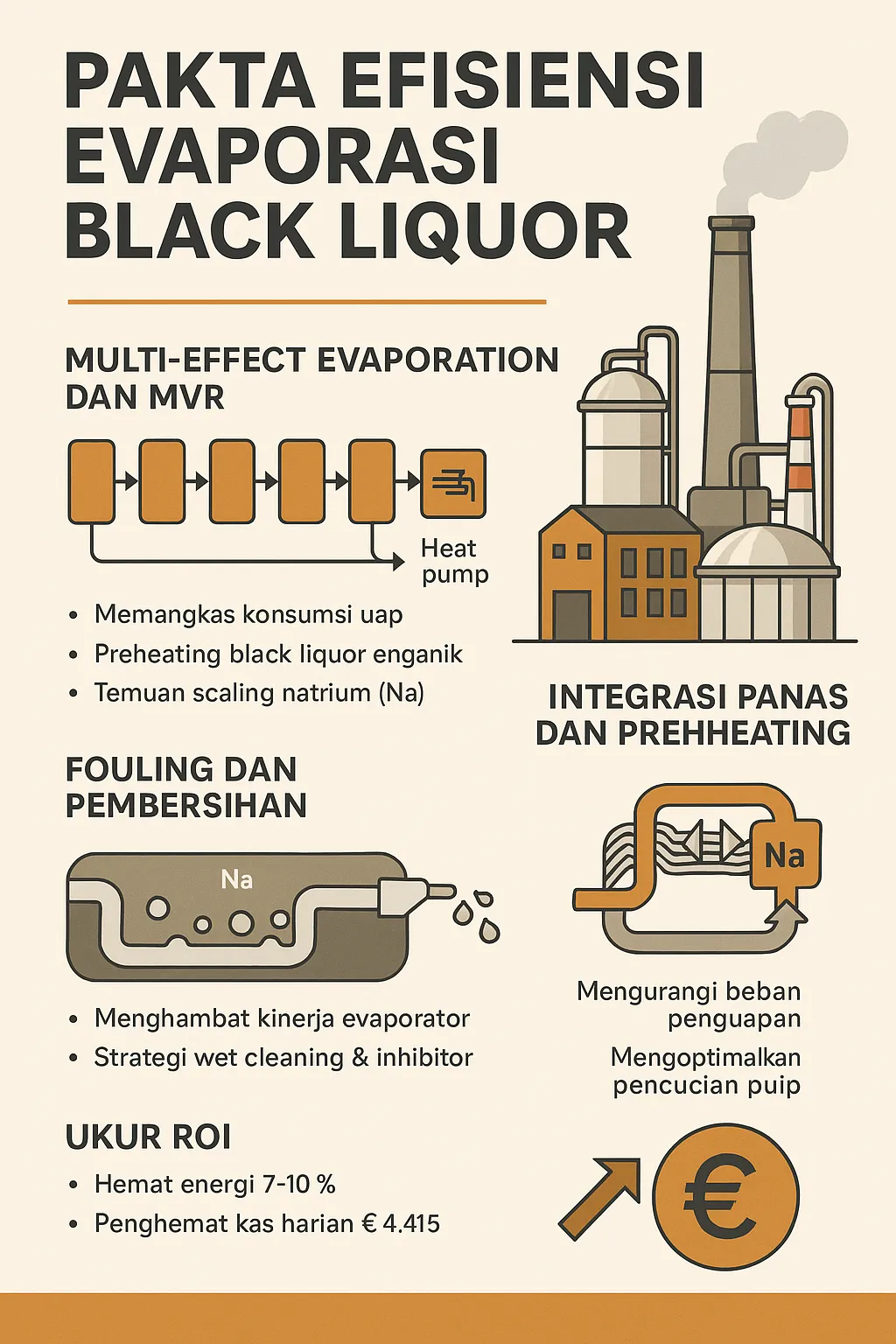
Ways to reduce scaling include wet cleaning (circulating dilute caustic or acid) and mechanical scrapers during shutdowns. In practice, these washing circuits depend on accurate chemical handling. Metering hardware such as a dosing pump can be relevant in implementation. Adding tall‑oil extract (a byproduct brine) just before high‑concentration effects has proven effective at dissolving or inhibiting Na₂CO₃/Na₂SO₄ crystals and delaying scale onset. Controlling liquor chemistry (pH, sulfate/carbonate ratio) helps too (www.degruyterbrill.com, www.degruyter.com). Where chemical scale‑control programs are applied, the aim mirrors the tall‑oil effect: inhibit sodium salt crystallization and keep U up (for industrial context, see scale inhibitors). Cleaning cycles still impose downtime and fresh water/chemical use. They add a hidden energy penalty because engineers must design for 100% duty at reduced U while frequent washes waste heat (www.degruyter.com, www.degruyterbrill.com).
Policy context and Indonesian upgrades
Indonesia, the world’s 8th‑largest pulp producer and 5th‑largest paper producer (infopublik.id), is pushing “green industry” measures toward 2050 net‑zero. The Ministry of Industry explicitly cites black liquor as a biomass fuel for steam and electricity, making upgrades like enhanced multi‑effect trains, MVR, and waste‑heat recovery directly aligned with national goals (infopublik.id). One Indonesian analysis notes that unutilized black liquor after evaporation represents a large missed energy opportunity; conversely, an optimized evaporator with heat integration maximizes black liquor’s bioenergy—on the order of 22 GJ per tonne pulp by burning the concentrated liquor (www.researchgate.net; www.researchgate.net).
The investment case matches policy: the MVR upgrade noted above paid back in ≈2.5 years (www.mdpi.com), and heat‑exchanger retrofits driven by pinch analysis often return capital in <2 years (www.researchgate.net).
Bottom‑line energy impacts
Modern mills can cut steam use by about 10–20% or more. They do it by upgrading black-liquor evaporators with more effects, mechanized recompression and full heat integration. Numerical studies and case data show that multi-effect plus MVR gives 7–10% energy savings (www.mdpi.com). Pinch-driven measures can save about 12%, or about 6 MW in a 600 t/d pulp mill (www.researchgate.net). Fouling remains the barrier. Without inhibitors and cleaning, sodium-salt scale can erase the gains (www.degruyterbrill.com).
Sources: Authoritative studies (MDPI, Nordic P&P Research J, energy‑efficiency guides) and industry analyses underpin the figures and paybacks here. Key citations include Variny (2023) and Karlsson (2020) on evaporation efficiency and scaling (www.mdpi.com; www.degruyter.com), an Australian energy guide (www.energy.gov.au; www.energy.gov.au), recovery‑boiler heat‑recovery analyses (www.mdpi.com; www.mdpi.com), pinch‑analysis casework (www.researchgate.net), and Indonesian policy/industry sources (infopublik.id).