

Article
Inside the boiler’s oxygen war: tray vs spray deaerators
Industry: Power_Generation_(HRSG) | Process: Feedwater_System
In the steam cycle, the deaerator does the quiet work of removing gas. Heat the feedwater to near its boiling point at the operating pressure, and dissolved oxygen (O₂) and carbon dioxide (CO₂) almost disappear. One engineering note says it plainly: “if the water temperature is raised to boiling point at the prevailing pressure… the partial gas pressure is zero.” Therefore almost all the oxygen leaves (Stork).
In practice, plants spray or cascade feedwater into a steam atmosphere until it is within a few °C of saturation (Veolia). Well‑designed spray/gas‑contact units vent roughly 97–98% of incoming oxygen simply by heating the water almost to saturation (Veolia), driving feedwater O₂ down toward 0.005–0.01 mg/L (5–10 ppb) in high‑pressure service (Asia Pacific Energy Policy; Veolia). Advanced plants often guarantee ≤7 ppb (≈0.005 mg/L) O₂ in feedwater (Veolia; Asia Pacific Energy Policy). By contrast, an atmospheric feedtank at ~85–90 °C holds on the order of 2 mg/L O₂ (Spirax Sarco), far above modern utility targets.
Any residual O₂ is usually removed with chemical scavengers (“trace amounts… may cause corrosion damage”) (Veolia). When needed, plants finish that last step with targeted chemicals such as oxygen scavengers.
Deaerator function and oxygen stripping
The deaerator is a pressurized feedwater heater. It removes dissolved gases by direct contact with steam. By Henry’s law and Raoult’s law, water at saturation holds almost no dissolved gas. Heating to the boiling point at the prevailing pressure drives the partial gas pressure toward zero (Stork).
In operation, the units spray or cascade the inflow to give more surface area and more residence time in a steam atmosphere. The target is a water temperature within a few degrees of saturation (Veolia). A well-tuned system vents about 97–98% of the oxygen at this stage (Veolia). The last traces are handled with chemicals downstream.
Spray-type versus tray-type designs
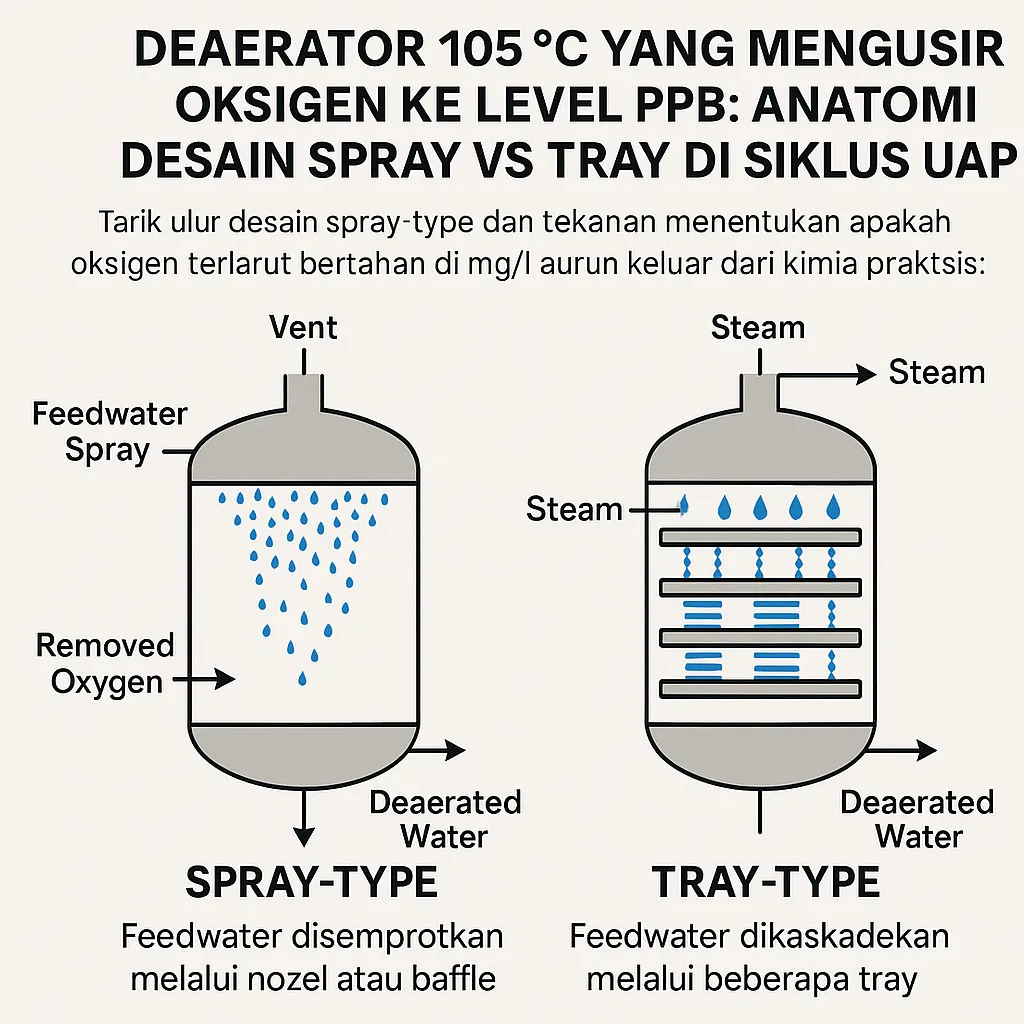
Spray-type deaerators inject feedwater through nozzles or baffles. This makes a fine spray in a compact, single-vessel layout that responds quickly to load changes. A modern spray unit can deliver less than 7 ppb oxygen from 10–110% load (Stork). These systems usually need only carbon steel construction, because the steel is exposed to a steam blanket with little O₂ (Stork).
Tray-type designs cascade water over multiple perforated trays, usually 10–24 tiers. Each step renews the liquid film area while crossflowing steam strips gases. The multi-tray arrangement keeps a large transfer surface independent of flow rate and keeps O₂ removal even at low loads. As flow falls, the film on each tray gets thinner, which keeps efficiency (Deaerator.com).
Trade-offs show up at turndown. Spray units usually need a large temperature rise (usually ~30 °C) and steady steam flow. Their degassing efficiency “seriously decreases” below ~25% load (Deaerator.com). However, vendors report spray systems that meet <7 ppb across 10–110% load and “~100% turndown” in practice (Stork). Many engineers choose tray or hybrid (spray-→tray) designs in large plants with wide turndown. Spray-only units fit steadier-duty or space-limited installations.
Economics tilt the decision. Spray systems usually need no oxygen scavenger to hit the <7 ppb spec, which saves chemical costs (Stork). Tray units usually still dose scavengers to lock in performance. Trays also tend to need stainless internals (higher capital cost) and more complex supports (Stork).
Operating pressure and temperature setpoints
O₂ solubility collapses as temperature rises: at 20 °C it’s ~9 ppm, at 60 °C ~5 ppm, at 90 °C ~2 ppm, and at 100 °C (saturation) essentially zero (Spirax Sarco; Stork). A feedtank at 85–90 °C sits around 2.0 mg/L O₂ (Spirax Sarco), hence the push to run slightly pressurized.
Because 100 °C at 1 atm risks cavitation, deaerators are commonly held at 0.1–0.3 bar g, bringing saturation to ~100–105 °C (Spirax Sarco). At 0.2 bar g (≈1.2 bar abs, sat ~105 °C), dissolved O₂ drops to ~0.005 mg/L (Asia Pacific Energy Policy). Many large boilers therefore aim at ≈0.2 bar g—Spirax notes a “saturation temperature of 105 °C” with manageable venting (Spirax Sarco).
Holding the setpoint pressure and temperature makes a big difference. It can cut O₂ by a factor of 100. Raising feedwater from 85 °C to 105 °C drops O₂ from ~2 mg/L to ~0.005 mg/L. Even a few degrees below design can spike residuals, because the gases dissolve back in. Plants use fast-acting steam control to keep operation steady. “A modulating control valve regulates” vessel pressure, so temperature “is guaranteed to be fairly constant” (Spirax Sarco). This helps “make use of steam…and improve fuel economy” (Spirax Sarco).
Operationally, an atmospheric hotwell at 70 °C instead of 85 °C would see O₂ rise by a multiple, while a well‑controlled deaerator at 105 °C pushes residuals into the ppb range (Asia Pacific Energy Policy). Because even tiny O₂ traces accelerate pitting at high pressure (Veolia), operators invest in monitoring—often with online O₂ analyzers—to verify the <7 ppb target is consistently met.
Sources and reference notes
Figures and guidelines—including O₂ solubility vs. temperature, “7 ppb guarantee,” “30 °C spray requirement,” and 105 °C setpoints—come from steam‑engineering handbooks and manufacturer data: Veolia; Stork; Asia Pacific Energy Policy; Stork (spray vs. tray); Deaerator.com; Spirax Sarco (O₂ vs T); Spirax Sarco (pressurised operation); Spirax Sarco (control).