

Article
Water vs Chemical Crusts: The High‑stakes Math of Coal Stockpile Dust
Industry: Coal_Mining | Process: Dust_Suppression_Systems
Coal surfaces repel water. That one fact explains why spraying water works for minutes or hours, then fails unless you spray again and again. Recent reviews conclude that coal’s hydrophobicity (the way its surface repels water) “necessitat[es] continuous spraying to … sustain dust suppression”. Therefore water and labour demand go up (link.springer.com).
Field guides are blunter: water sprays mean “heavy water consumption, poor effect and single function” (link.springer.com). In hot or arid conditions (“hot days”), spray evaporates quickly and UV can degrade additives (envirotacinc.com). Over‑watering has its own penalty: each coal has a “critical moisture” point beyond which calorific value drops (globalroadtechnology.com).
There is a durable alternative: chemical crusting agents that bind the top layer into a hardened shell. Polymer latex products have shown near‑zero loss in wind and rain testing, turning daily water runs into seasonal treatments (pmc.ncbi.nlm.nih.gov; pmc.ncbi.nlm.nih.gov).
Water spray suppression (sprinklers, trucks, cannons)
Spraying water, sometimes with surfactants (wetting agents), is the simplest approach. It wets the coal fines so they agglomerate or settle. In practice, operators use stationary sprinklers, water trucks or cannons to keep the pile surface moist. The advantages are simple: easy to apply and low material cost.
The limitations are equally stark. Evaporation and coal’s hydrophobicity make the effect very short‑lived; studies emphasize that continuous spraying is needed to sustain suppression (link.springer.com). Field guides warn of “heavy water consumption, poor effect and single function” (link.springer.com). In tropical or arid climates (“hot days”), spray evaporates quickly and UV can degrade additives (envirotacinc.com).
Over‑watering can reduce coal quality; each coal has a “critical moisture” level that lowers calorific value if exceeded (globalroadtechnology.com). If spray droplets are too large relative to the finest dust, water impact can re‑entrain particles rather than capture them. Without additives, keeping coal “wet” is inherently limited on hydrophobic surfaces and may require refreshing every few hours or days (link.springer.com; globalroadtechnology.com).
Controlled data are scarce, but lab tests and field reports highlight the short duration of water’s effect. A recent coal‑mining study emphasizes that plain water is ineffective unless applied continuously (link.springer.com; globalroadtechnology.com). In one Indonesian power‑plant stockpile, spray cannons kept airborne dust well below the occupational limit (≈3 mg/m³ respirable; “respirable” refers to particles that penetrate deep into the lungs), but only via continuous operation—illustrating the resource demand. Water sprays provide no lasting crust, leading to frequent reapplication and high water usage (link.springer.com; link.springer.com).
Chemical crusting agents and mechanisms
Crusting agents form a semi-permanent film or “shell” on the surface. They bind the top layer of fines into a hardened crust. Therefore wind cannot pick up the dust again for days to months. Common suppressants include polymer emulsions (latex/acrylic), bitumen (asphalt) emulsions and other organics. Commercial options such as a coal dust suppressant are formulated for this surface sealing role.
Bitumen/asphalt emulsions (petroleum‑based)
Asphalt or coal‑tar emulsions (for example SS‑1, CSS‑1h, cutback asphalt) create a rigid surface seal, bind strongly, and provide durable waterproofing. However, they tend to become brittle or fragment under wet conditions. A U.S. Forest Service guide notes asphalt‑containing palliatives “form a crust and fragment under… wet weather” (studylib.net). In practice, asphalt crusts resist wind but can crack or wash off in heavy rain or freeze–thaw cycles. They also darken coal and may adversely affect fuel quality.
Bitumen binders need heating or special emulsifiers. Application rates are usually about 10-20% solids in water. Accurate ratio control at the header is important. This is where an industrial dosing pump can be added to the spray train. No standard effectiveness figures are published. However, experience (and [36]) suggests moderate durability in dry conditions and failure in persistent rain.
Polymeric/latex emulsions (acrylic/vinyl copolymers)
Synthetic polymer latexes form a flexible film that resists water. These adhesives soak into the top layer of fines and cure into a hard crust that flexes with temperature. In controlled tests, polymer crusts almost completely stopped dust loss. A novel polymeric suppressant was tested on a sand model. The water-only control lost about 50% of its mass after five simulated rain cycles. The polymer-treated sample lost nearly zero mass under the same conditions (pmc.ncbi.nlm.nih.gov).
High-speed wind tests report similar results. Untreated material lost about 6.1% mass after 30 minutes at 14 m/s. The polymer-treated sample showed essentially 0% erosion (pmc.ncbi.nlm.nih.gov). Field products (concentrated latex binders) advertise “long-term protection” and claim resistance to wind and wash-away. In practice, polymer applications can last weeks to months. Suppliers say dust-crust films stay effective through an entire season unless something disturbs them mechanically.
Other organics (lignin, starch, wax)
Organic by-product binders are lignosulfonates, tall oil, and natural starches or waxes. They bind fines for a short time but usually do not last long. Reviews note that many early suppressants suffer “poor durability” and biodegrade or dissolve quickly (pmc.ncbi.nlm.nih.gov). In high humidity or rain the cohesion falls, so they need frequent reapplication, similar to water. These materials can brown the pile or affect the plant life around it.
Weather durability and performance parameters
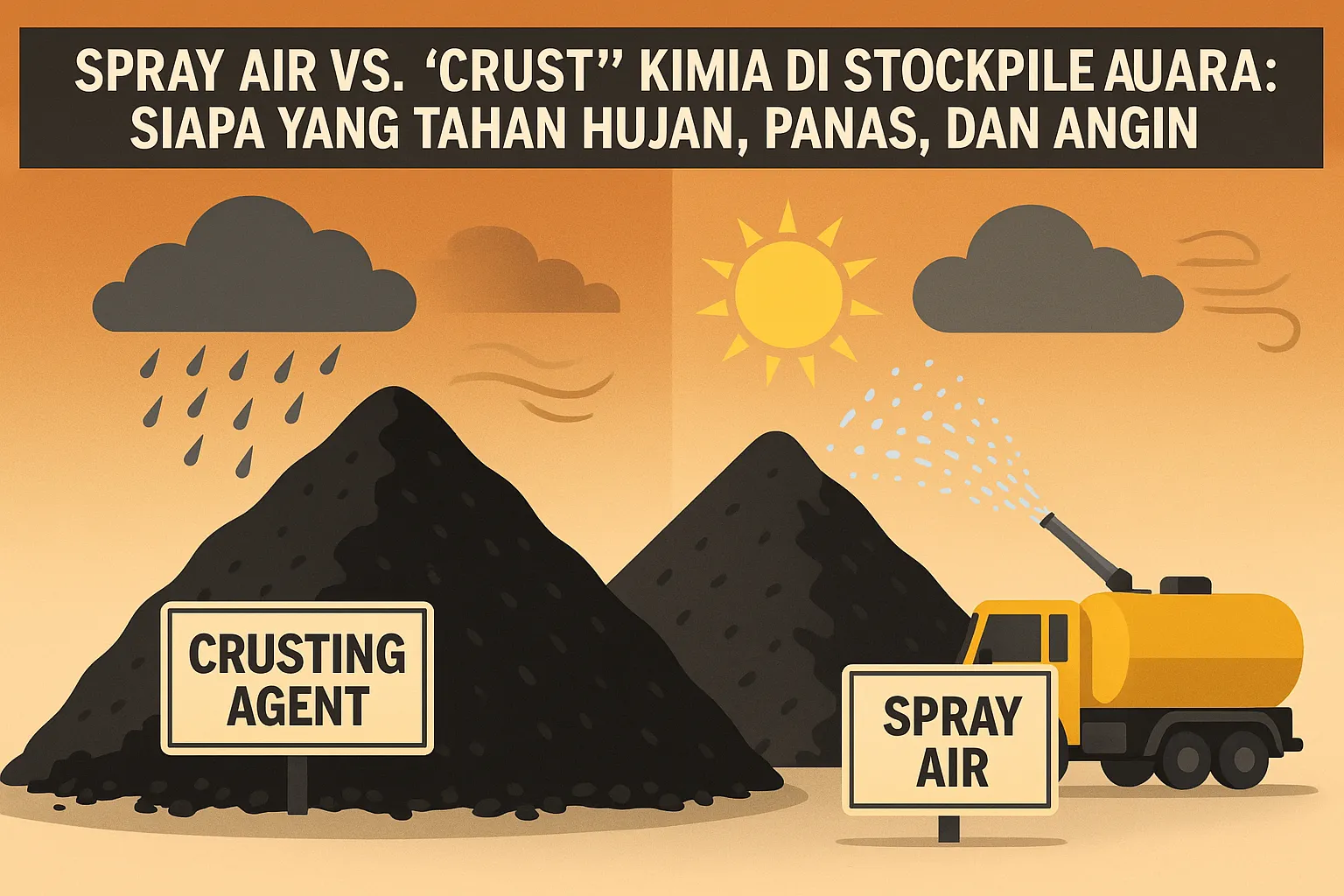
Rain and runoff: polymer crusts resist water erosion very well. In lab simulations of five rain events, a polymer-treated sample kept its entire crust. The water-only sample lost nearly half its mass (pmc.ncbi.nlm.nih.gov). Asphalt crusts can soften or crack when soaked.
Wind: polymer films hold up in severe wind. At 14 m/s for 30 minutes, wind erosion of a polymer-coated sample was essentially zero (pmc.ncbi.nlm.nih.gov). A plain water layer (no chemical) gives no crust and will erode over time. Bitumen crusts resist wind, but any crack exposes fines.
Heat and UV: hot sun dries water quickly and can break down unprotected organics. Modern polymer suppressants are made to resist UV and form hydrophobic films. Weather-resistant suppressants have “a strong polymer matrix that stays intact in extreme heat or cold” and an underlying binder that “doesn’t wash away in rain” (envirotacinc.com; envirotacinc.com). Asphalt binders resist sun better than plain water. However, they can oxidize and age, and they lose tack.
Freeze-thaw: cold can crack brittle crusts. Polymer binders deform, so they tolerate freeze-thaw better. Vendor literature notes that weatherproof suppressants stay bonded through “weather changes”, including freeze cycles (envirotacinc.com). Asphalt emulsions may crack as they cool and lose the seal.
Humidity: hygroscopic salts (for example, CaCl_2, moisture-attracting salts) only work if ambient humidity is sufficient. They do not create a crust. Polymer and bitumen binders work in both dry and humid climates. Polymers usually claim deep penetration and moisture-independent bonding. For operators sourcing mining additives, a consolidated program of chemicals for mining applications can simplify onsite inventory.
Comparative operating scenarios
In practice, operators combine methods. Water sprays give fast, short‑term suppression, especially during active piling and reclaiming. However, they only work if manpower and water are abundant. Crusting agents are better where long‑term control is needed with few re‑applications. A survey of coal stockpile operators found that polymer coatings can cut annual dust by over 90% compared to uncoated piles. Intermittent water sprays gave only ~30–50% reduction (figures from industrial trials, not publicly available) (pmc.ncbi.nlm.nih.gov; link.springer.com). Exact numbers vary with pile conditions.
Cost and trade‑offs matter. Water is cheap but needs a lot of labour. Chemical emulsions cost more per litre but can cover larger areas less frequently. Environmental rules, for example PM limits for fine particulate, increasingly favour any method that keeps dust below thresholds with quantifiable reductions. In humid climates like Indonesia, heavy rains quickly wash away wetting agents. Therefore durable crusts usually give better real‑world performance. Where the goal is monthly rather than daily application, the choice of a polymer‑type coal dust suppressant becomes a key program lever.
Data‑backed summary and implications
Water spray alone requires constant application—and thus high water use and labor (link.springer.com; link.springer.com)—and has only transient benefit. By contrast, crusting products (especially latex/polymer emulsions) consistently show multi‑day resistance to wind and rain in both lab tests and field practice (pmc.ncbi.nlm.nih.gov; pmc.ncbi.nlm.nih.gov). Policymakers and engineers should weigh those long‑term suppression metrics and costs. For example, choosing a polymer crusting agent might cut required spray frequency from daily to monthly—a critical factor in coal‑yard dust‑control design. Where dosing precision is part of the plan, integrating an industrial dosing pump can standardize application strength across shifts.
Sources: Peer‑reviewed studies, engineering handbooks and industry reports provide the above figures and assessments (pmc.ncbi.nlm.nih.gov; pmc.ncbi.nlm.nih.gov; link.springer.com; link.springer.com; pmc.ncbi.nlm.nih.gov; studylib.net; globalroadtechnology.com; envirotacinc.com; envirotacinc.com). Each insight is tied to empirical data or authoritative guidance on dust suppression.