

Article
The Mine’s Dust Super‑Emitter Is Hiding in Plain Sight Here’s How Operators Are Beating It
Unpaved haul roads drive 78–97% of fugitive dust at open‑pit coal mines. A build‑maintain‑treat playbook—then the right chemical—can push suppression to 95–100% and keep sites within tight PM10 limits.
Industry: Coal_Mining | Process: Dust_Suppression_Systems
Across open-pit coal mines, the dirtiest source is not a stack or a shovel. It is the road under the trucks. Unpaved haul roads account for about 78–97% of total fugitive dust emissions (www.researchgate.net). That is a direct compliance problem where ambient standards are strict. Indonesia’s 24-hour PM10 (particulate matter 10 micrometers and smaller, inhalable) limit is 150 µg/m³ (id.scribd.com).
Best practice is to design out dust first, then maintain the surface, and only then add chemical suppressants. Mines increasingly use commercial programs for this, including a dedicated hauling‑road dust suppressant, to improve visibility, reduce machine wear and meet ambient compliance while trucks keep rolling.
Road construction specifications
Dust is much lower when the road prism is stable, well drained and tightly compacted. Wearing courses for large trucks should be thick, well graded and dense. Usually this means at least 150–200 mm of crushed or sub-angular gravel, placed in two or more lifts (usually 100–150 mm each) and compacted to ≥95% of Modified Proctor dry density (a standard lab compaction benchmark) (studylib.net). “Sheathing” with enough fines matters. Without a cohesive fine matrix, coarse gravel scatters and makes dust. As one guide puts it, the wearing course must meet specification and be compacted correctly. If not, the road will perform poorly (studylib.net).
Cross-section and drainage matter just as much. Crown the surface about 2–3% so water runs to the side ditches. Size the ditches so they can carry storm runoff. Weak spots (soft subgrade, unbonded layers) need to be stabilized or removed. If the base is not compacted enough, the road ruts. The ruts crack the fines and undermine any surface treatment (globalroadtechnology.com). The decisions made at build time decide how well the road works later (globalroadtechnology.com).
Road maintenance practices
Even a good road needs constant attention to keep dust down. Routine grading restores the crown/profile, moves displaced aggregate back, and works fines into the surface. Best practice is to rip or loosen the top 75–100 mm, remix across the width, and re-compact in lifts (studylib.net; studylib.net). If the wearing course falls below ~75 mm, grading will mix base into sheeting. It is better to loosen, place fresh sheeting to the design width, and re-compact (studylib.net).
Fines management is a key part. Under traffic, even good aggregate breaks down and the clay fraction grows. Therefore the road becomes dusty when it is dry (globalroadtechnology.com). When the top ~50 mm becomes “bony” (mostly gravel), deep rip and remix brings fines to the surface and cuts dust. This means excavating 50–100 mm, mixing in fresher subgrade and re-compacting (globalroadtechnology.com). On high-volume roads, full resheeting is usually needed every 6–12 months (news.dustaside.com.au).
Moisture conditioning helps treatments penetrate and hold. Dampen the surface before you apply the product (www.fs.usda.gov). Watering must be even, and spray-bar trucks are standard for this. Many operations run scheduled water trucks because they know plain water does not last (see performance data below). When you blend brines or polymers into spray trucks, many sites use a simple dosing pump to keep the dose consistent. Speed control, load management, less tire carry-over and wheel wash practices also cut scatter and fines loss.
Chemical suppressant classes and mechanisms
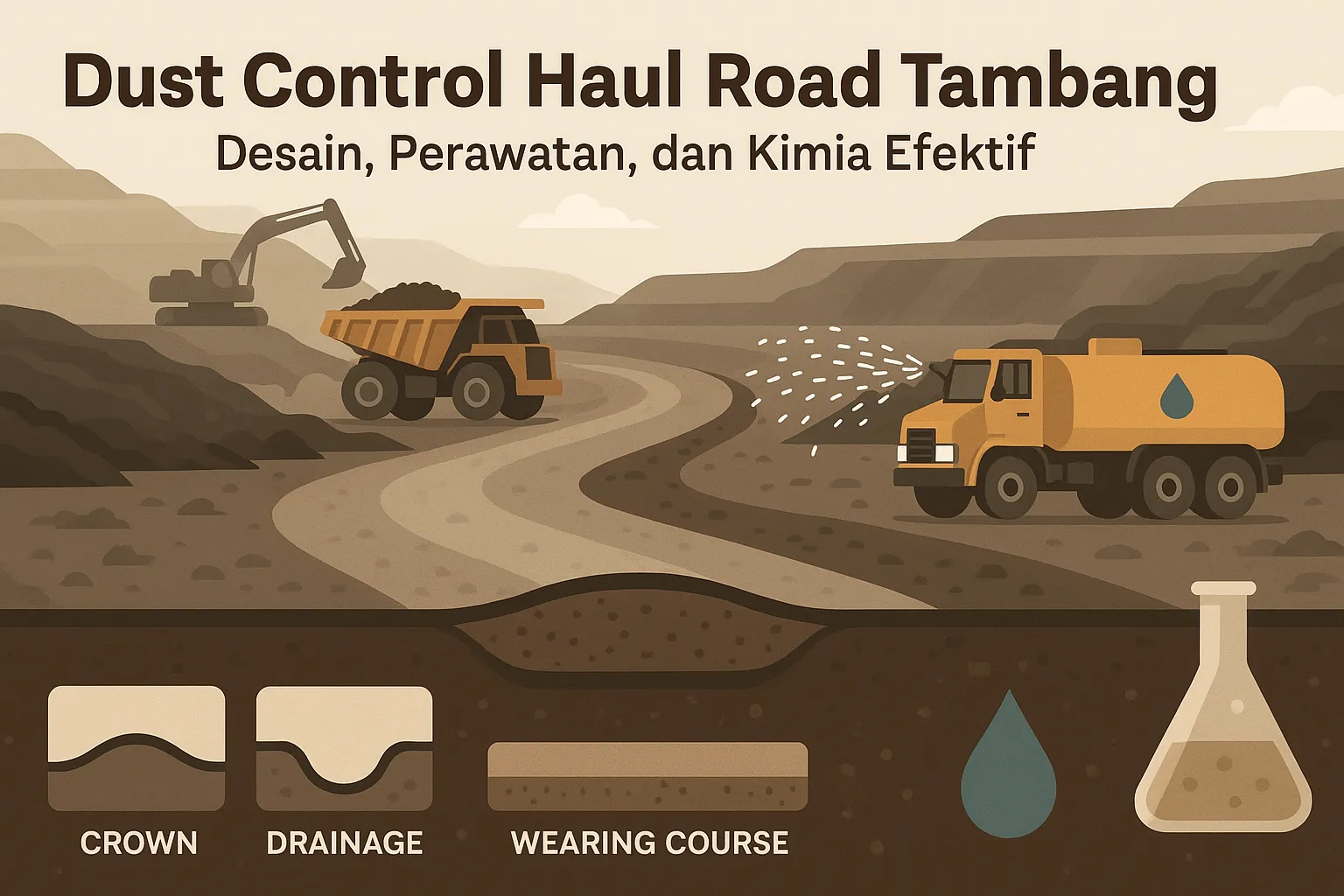
Plain water, hygroscopic salts, oils, organics, enzymes and ionic agents, synthetic polymers, and clay additives all play a role. Each one has tradeoffs in longevity, cost, and environmental profile (classification per USDA dust‑control guidance: www.fs.usda.gov; www.fs.usda.gov). Applications are usually topical sprays carried by water. “Concentration” refers to the solids content in the water.
Water-only: plain water wets the fines and gives an immediate effect, but a very short one.
Hygroscopic salts (deliquescents): Magnesium chloride (MgCl₂) and calcium chloride (CaCl₂) brines attract water. These salts absorb moisture from the air and the soil and “cement” the fines (www.researchgate.net). Lab work shows MgCl₂ can remove near 100% of PM10 under cross‑wind conditions (www.mdpi.com). Wind‑tunnel and field studies report reductions of 94% or more even 2–6 weeks after application. Ultra‑saline “Dead Sea” brine has shown effectively 100% suppression (www.researchgate.net). Typical use is flake or liquid brine at about 15–30% concentration, about 1–3 L/m² (about 150–300 g/m² salt). It lasts weeks to months unless it is leached (www.researchgate.net; www.researchgate.net). The drawbacks are corrosion, soil salinity and wash‑off in heavy rain. Sodium chloride (rock salt) is least effective. It is only slightly hygroscopic and needs a higher application.
Asphaltic/petroleum oils: Cut-back asphalt, dust oils and bituminous emulsions coat the particles. As the water evaporates, a film binds the fines. Immediate reductions are typical, but they vary widely. One estimate showed about 70% TSP reduction for a standard dust oil, against about 95% for MgCl₂ under similar conditions (www.researchgate.net). Rates run at about 2–5 L/m². They resist short rains, but they can make the surface slick and they need periodic reapplication.
Lignosulfonates and other organics: Lignosulfonates (pulp‑industry byproducts) are natural polymers. They form a glue‑like film when they dry, and the film binds soil particles (globalroadtechnology.com). They are not hygroscopic. Once cured they hold fines mechanically, so they work well in dry climates. Typical application is ~20–30% solids, ~2–4 L/m², with 1–2 treatments per season (globalroadtechnology.com). Field performance usually shows 70–80%+ reductions in dry weather. However, LS can be ineffective on very coarse, low‑fines roads and readily re‑dissolves in rain, sometimes leaving slick surfaces (globalroadtechnology.com; globalroadtechnology.com). Other organics—molasses/sugar emulsions, tall oil, vegetable oils—act similarly as film‑forming binders. They last in dry weather but lose efficacy when oversaturated by rain.
Synthetic polymers: Modern acrylics, vinyl acetates, polyacrylamides, and related binders can outperform simpler agents. Polyvinyl acetate has shown near‑complete wind‑blown PM10 elimination on loess soils in lab trials (www.mdpi.com). Field coatings form semi‑permanent crusts that resist wash‑off. Typical rates are ~0.5–2 L/m² of concentrated product, diluted 1:5–1:10 with water. These “24/7” products have kept roads open in rain and drastically reduced conventional maintenance (globalroadtechnology.com). Caveats: higher cost and a need to match the formulation to the material. Heavy blading can destroy the crust, so maintenance shifts to brushing or light raking (globalroadtechnology.com).
Miscellaneous: Enzymatic and ionic additives and clay additives such as bentonite or montmorillonite are niche tools. Results are mixed. They are usually used in combination and they act more slowly.
Relative performance and field data
Water: Water alone suppresses dust briefly and does not bind it. US EPA field tests found that 2.08 L/m² gave about 74% TSP (total suspended particulate) reduction for 3–4 hours. 0.59 L/m² gave about 95% but only for 30 minutes (www.researchgate.net).
Salt brines: In lab and wind‑tunnel work, hydrated MgCl₂ produced essentially zero new PM10 across tested wind speeds (www.mdpi.com). On contaminated desert soil, CaCl₂ and MgCl₂ each gave ≥94% PM10 suppression six weeks post‑application; highly concentrated brine achieved 100% suppression under all winds (www.researchgate.net). Katra (2019) also observed that reducing applied MgCl₂ concentration still kept emissions “low” (his Figure 7) (www.mdpi.com). The effect is due to the salts themselves, which cement fines until leached or exhausted (www.researchgate.net).
Lignosulfonates: Controlled tests report strong reductions (often 70–90%) on gravelly surfaces in dry climates. Limitations appear on very coarse, low‑fines roads and when humidity rises, as LS may wash off (globalroadtechnology.com; globalroadtechnology.com).
Oils/asphalts: Reductions of about 60–80% right after drying are common. However, UV and traffic weather the films. A field trial reported about 70% TSP reduction for a standard dust oil versus 95% for MgCl₂ under similar conditions (www.researchgate.net).
Synthetic polymers: Lab data show polymer binders can approach the efficacy of salts (www.mdpi.com). In practice, polymer emulsions have enabled “permanent” (>1‑year) stabilization of high‑traffic haul roads at some mines (globalroadtechnology.com). One site reported haul‑truck operator dust exposure dropped by 41–52% after treatment compared with water trucks or no treatment (www.researchgate.net). In a Chinese open‑pit, a polymer‑surfactant “SSC” in water spray achieved ~89% suppression of both total and respirable dust—~45% more effective than water alone (www.researchgate.net; www.researchgate.net). Polyacrylamide‑type polymers have also delivered 30–60% additional reduction under wind conditions (www.researchgate.net).
Other organics: New data from a semi-arid Chinese mine shows a molasses-based suppressant giving a higher efficiency than water. Field trials usually report a reduction of more than 80% (pmc.ncbi.nlm.nih.gov).
Selection framework: material, climate, traffic
Road material: Fines content is the first filter. Coarse gravel or hardpan with <10% passing 75 µm offers little “native binder”. Therefore a chemical that bonds coarse particles may be needed, usually a polymer emulsion, a polymer+oil blend, or repeated heavy watering. Where fines are abundant (sandy-silt mixes), hygroscopic salts or lignosulfonate can clump the matrix well. If fines are <10%, application rates must rise or fine material should be added (www.fs.usda.gov). High clay content can crack when dry. Therefore flexible polymer seals are better.
Climate: In dry climates with little rain, chlorides and organics work well. MgCl₂, CaCl₂ and lignosulfonates stay in place and hold moisture. Lignin is valued in deserts because it is not hygroscopic and gives long-lasting protection (globalroadtechnology.com). In humid or rainy climates, water-soluble products leach quickly. Oils, polymer emulsions or paving are favoured, and heavy rainfall still sets the reapplication schedule. Temperature matters. Heat can speed up curing and volatilization. Cold can slow film formation.
Traffic volume and use: More traffic and higher speed need stronger palliatives and more applications (www.fs.usda.gov). Long-haul, 24-hour roads with Class-A trucks usually justify premium stabilizers (polymers or soil-cement) to keep constant uptime (globalroadtechnology.com). Lower-traffic or seasonal roads can use cheaper intermittent fixes (water trucks or salts). Where operator exposure is important, full elimination (favoring polymers) may come first. Where only off-site fugitive dust matters, simpler suppressants can be enough.
Management and cost: Repeated watering uses labour and scarce water. Polymers cost more per unit but can cut watering frequency and road wear. Total-cost analyses (Thompson & Visser 2007) show that at sufficiently high traffic, or when water is scarce, chemical suppressants can beat watering on economics (journals.co.za). You also need to weigh maintenance compatibility (for example, minimal blading after polymer treatment), safety (slipperiness) and corrosion (for salts) (globalroadtechnology.com).
Illustrative selection examples
Coarse rocky road, arid, light traffic: CaCl₂ brine or CaCl₂ salt, or moderate lignin.
Coarse road, high rain: Polymer emulsion or bituminous seal (salts wash out).
Fine-grained (silty) road, moderate traffic, seasonal: Lignosulfonate or MgCl₂, or polymer if the budget allows.
Fine-grained, heavy traffic: Moisture-stable polymer or triple-thick compaction with occasional salt.
Wet tropics: Bitumen-seal sheets or constant watering (salt corrodes and washes out).
A site where water is expensive: polymers or lignosulfonate. Salts use water too, but they lock it in.
Measurable outcomes and monitoring
Single, appropriate chemical applications often deliver 80–100% suppression for days to weeks; MgCl₂ has kept PM10 emissions near zero for weeks in comparative tests (www.mdpi.com; www.researchgate.net). By contrast, water spraying typically achieves ≈50–75% reduction and only for minutes to hours (www.researchgate.net). Liao et al. (2018) documented an 89% reduction in total dust and 88% in respirable dust using a surfactant suppressant in a coal‑mine roadway (www.researchgate.net). These inputs are directly useful in dust modeling, including AP‑42 equations (emission‑factor equations).
Quantitative verification matters. Many operators use portable PM10 samplers before and after treatment. Then they adjust the application rates or switch the chemistry. Around conveyors and transfer points, a coal dust suppressant can work alongside the haul-road program. It keeps ambient levels stable and improves visibility close to the source.
Market trend and procurement
Demand for dust‑control chemicals (hygroscopic salts, lignins, polymers, oils) is expected to grow about 5–6% per year globally. Stricter regulations and expanding mining and construction drive this growth (www.sphericalinsights.com). Indonesian coal companies want to meet regulatory limits and keep downtime low. Therefore they are adopting commercial dust‑control systems, usually polymer‑ or chloride‑based, along haul roads and conveyors. Sustainability concerns are pushing “greener” options (bio‑polymers, molasses) into research and pilots. Procurement is increasingly bundled under broader chemicals for mining applications to standardize formulations and service across pits.
Implementation notes and product integration
Applications are usually topical sprays carried in water. Concentration refers to the solids content. Blending accuracy matters, especially when MgCl₂ concentrations are stepped down as Katra (2019) did while keeping emissions low (www.mdpi.com). For this, operators usually fit spray bars with a dosing pump. On the haul network, mines standardize a core hauling‑road dust suppressant and add lignin or chlorides by season and pit geology.
Conclusions and site‑specific recommendations
Integrated programs work. Build to spec (thick, dense sheeting; good drainage), maintain aggressively (grading, compaction, moisture), then match a suppressant to material, climate, and traffic. Matched to conditions, good binders can remove about 95–100% of dust. Water alone does far less (www.mdpi.com; www.researchgate.net). In humid southern Kalimantan, polymer stabilization may work better than lignin (to avoid wash‑out). In inland arid Sumatra, a hygroscopic salt may be enough. Check the result with PM10 samplers, then write the measures into the dust‑control plan to meet Indonesia’s air‑quality and mining regulations. Around fixed plant, add a targeted coal dust suppressant to the road program where needed.
References used throughout include Katra (2019) on haul‑road suppressants (www.mdpi.com; www.mdpi.com), Raveh‑Amit et al. (2022) on chloride efficacy (www.researchgate.net), US EPA/Forest Service guides (www.researchgate.net; www.fs.usda.gov), and industry reports (globalroadtechnology.com; globalroadtechnology.com), as cited above.