

Article
The auto industry’s dirtiest water meets its match: radicals vs incinerators
Industry: Automotive | Process: Industrial_Wastewater_Treatment_(Oily_&_Metals)
Metal forming and plating create oily wastewater with high COD (chemical oxygen demand). So does painting and degreasing. This wastewater carries hydrocarbons, surfactants and toxic metals. Conventional biological treatment does not remove them. These “recalcitrant” organics are petroleum-based oils, paint resins and glycol solvents. They can poison the microbes and stay in the effluent.
Fenton’s reagent (Fe²⁺/H₂O₂) and ozone/peroxide systems make hydroxyl radicals (•OH). This oxidant has an oxidation potential of ≈2.8 V and “reacts very rapidly with most organic compounds”. It is not selective, and it oxidizes them toward CO₂ and H₂O (IntechOpen; IntechOpen). In practice, these radicals break C–C and aromatic bonds in oils and surfactants. They cut them into smaller acids and in the end into inorganic end‑products. This can turn biologically inert sludges into biodegradable intermediates, which raises the BOD/COD ratio (BOD is biochemical oxygen demand measured over five days). In some cases it also gives near‑total mineralization (IntechOpen; IWA Publishing).
Radical chemistry and recalcitrant organics
Biological resistance comes from the molecular stability of compounds like polyaromatics or chlorinated phenols. AOPs overcome this with radical chemistry. Fenton’s reagent produces •OH at once, and it oxidizes aromatic rings and alkanes without selectivity. Ozone in water, especially with added H₂O₂ (“peroxone”), forms chain-peroxide species and •OH that attack the recalcitrant parts (IntechOpen).
Reviews say AOPs were developed to oxidize non‑biodegradable organics, including persistent industrial solvents, to harmless CO₂/H₂O. They reach near‑complete mineralization when dosing, contact time and catalysts are optimized (IntechOpen; IntechOpen). Fenton has been shown to destabilize oil emulsions and degrade petroleum ethers in water. Ozone readily consumes double bonds and phenolic groups in solvents (US EPA).
Performance on high‑COD automotive streams
Empirical results match the chemistry. A 2025 Fenton pretreatment trial on automotive paint/filter wastewater (high COD with heavy metals) reported ~50% COD removal under the best conditions, 0.58 g/L Fe²⁺, H₂O₂:COD 0.58 mol/mol, 30 minutes. It also gave a large lift in biodegradability. Sludge inhibition fell from 44% to 9% after treatment (Springer; Springer).
A pilot-scale ozonation test on oily “tank-truck cleaning” waste, a solvent and oil concentrate, removed up to 56% of the COD and raised the BOD₅/COD ratio to >0.54. The study concluded that “ozonation was feasible to remove recalcitrant COD”. The ozonated effluent could then go to biological treatment, so the water could be reused (IWA Publishing).
Bench-scale reports find that Fenton on different industrial effluents usually gives about 40–90% COD reduction, and the result depends on the dose. One study reached 96% COD removal from a tobacco wastewater in jar tests (US EPA). Automotive effluents usually start in the thousands of mg/L COD. Cutting even half can come close to regulatory discharge levels (usually <100–300 mg/L COD). AOP pretreatment can turn a biologically “dead” effluent into one with significant biodegradable fractions (IWA Publishing; Springer). Incineration or off-site disposal would simply remove the organics outright, but at much higher cost.
Cost–benefit: AOP vs incineration and disposal
AOPs need on-site equipment (oxidant generators, reactors, mixers) and a continuous input of chemicals and energy. Large-scale ozonation capex lands “in the millions,” and annual O&M is usually in the “hundreds of millions” of dollars. However, per-unit costs drop as flow increases (ITRC). One survey reports ozone-based treatment costs of about $0.10–0.50 per m³ of water treated (ITRC).
For peroxide systems, heavily polluted water usually needs about 0.5–1.0 kg H₂O₂ per m³. Therefore the chemical cost is on the order of $0.30–1.00/m³. At a mid-size 100 m³/day plant, OPEX is therefore on the order of a few thousand dollars per month, excluding electricity and maintenance.
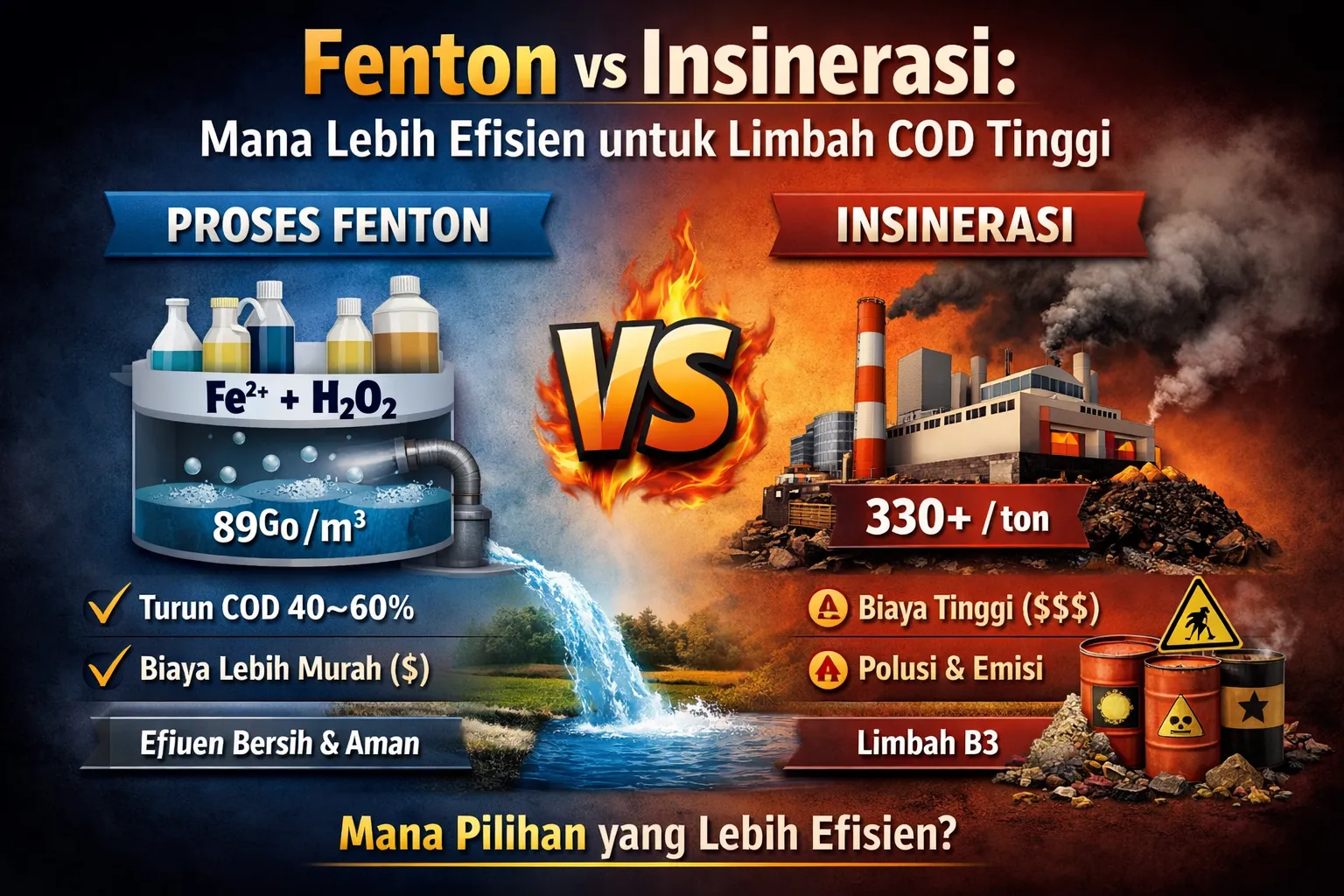
Off-site disposal charges add up quickly. In Indonesia, hazardous organic wastes are classified as B3 (very hazardous) and handled by specialized contractors. A cost survey in East Java found stabilized hazardous waste landfill fees of about USD 380/ton, direct landfill $175/ton, and fuel-blending $425/m³, with weighted averages ~$330/ton overall (ResearchGate). Using the conversion 1 ton ≈ 1 m³ for dense sludge, that is ~$0.33/kg or ~$0.33/L of waste. That is orders of magnitude higher than AOP’s per-liter treatment costs. Disposing 10 m³ of oily concentrate (~10 tons) could cost ~$3,300.
On-site incineration avoids trucking but needs a lot of capital and energy. A modern incinerator (for example Indonesia’s PT PPLI facility) is a multi-million-dollar complex that “destroys waste and the pollutants it contains”, from oil/paint sludges to solvents, by high-temperature combustion. It needs a lot of fuel and flue-gas scrubbing. It also produces CO₂ emissions, and air toxins are possible (PPLI).
Net benefits, drawbacks, and hybrid strategies
AOP turns wastewater from a disposal cost into a treatment route. Treated water can usually be discharged or reused on-site. That saves fresh water and disposal fees. In the tank-truck example, the authors noted their ozonation + biological process “provides a useful solution for ROC streams…making water reuse possible” (IWA Publishing). One analysis of Fenton pretreatment also reported a 6.6–16.6% cut in life-cycle CO₂ emissions versus conventional coag-floc pretreatment (Springer).
There are trade-offs. Fenton produces iron sludge and leaves residual oxidant. The systems need careful pH control and oxidant safety. Incineration leaves residual ash/char that needs disposal, and it can emit dioxins or NOₓ if it is not managed perfectly. Disposal or incineration moves the environmental risk to another site. AOP contains it on-site.
In cost terms, AOP pretreatment usually runs $0.1–1.0 per m³ of wastewater (ITRC) versus hundreds of dollars per ton for off‑site handling (ResearchGate). For very concentrated oily wastes, volumetric AOP treatment, possibly combined with volume concentration, usually comes out cheaper than hauling. It also reduces regulatory liability because it destroys hazardous organics in situ. Incineration is effective. However, it is only practical at large scale because of its massive capital and energy cost.
A hybrid approach usually makes sense. Use AOP to partially oxidize and detoxify the waste. Then send any inertified residue for disposal or modest incineration to minimize the truly “hazardous” volume.
Equipment integration for AOP trains
Fenton’s reagent needs accurate chemical addition. Therefore plants specify metering gear, such as a dosing pump for hydrogen peroxide and iron salts, to control the H₂O₂:COD ratio and the reaction time (</products/dosing-pump>).
Free oil is usually separated upstream of oxidation in automotive wastewater trains, using primary systems. These include screens and skimmers designed for physical separation (</products/waste-water-physical-separation>).
Dedicated oil separators help cut free oil to low ppm levels before radical chemistry takes over. This reduces fouling and improves contact (</products/oil-removal>).
Fenton’s iron hydroxide sludge and oxidized particulates are usually settled before downstream steps. Compact lamella plates can reduce the footprint compared to conventional basins (</products/lamela-settler>).
AOP boosts biodegradability. For example, BOD₅/COD was above 0.54 after ozonation in the pilot. Therefore biological polishing becomes viable. Moving‑bed bioreactors provide a resilient biofilm platform for that phase (</products/moving-bed-bioreactors-mbbr>).
Where reuse is the goal, biological treatment combined with membrane separation can produce high-quality effluent suitable for internal loops. This aligns with the studies’ water-reuse pathway (</products/membrane-bio-reactors-mbr>).
Bottom line for automotive plants
Oxidation with Fenton or ozone/H₂O₂ breaks the backbone of inert organics in oily automotive waste streams. It gives large COD/C‑TOC reductions (usually 40–60% per pass) and opens the way for biological steps that follow. The cost is well below hauling or incineration (Springer; IWA Publishing; ITRC; ResearchGate). Oxidant costs and iron sludge management are real. However, preventing “truckloads of hazardous sludge” in the first place can be worthwhile economically and environmentally. This is especially true as organic concentrations rise.
Sources: Ullah et al. (2025) on Fenton for automotive rinse waste (Springer); Poelmans et al. (2023) on pilot ozonation of oil‑laden concentrates (IWA Publishing); Krystynik (2021) AOP chemistry (IntechOpen; IntechOpen); US EPA AOP handbook (US EPA); cost analyses (ITRC); and Indonesian waste regulation/costs (ResearchGate; PPLI).