

Article
Inside the crack: Ripple mills vs. centrifugal nut crackers in palm oil
Industry: Palm_Oil | Process: Kernel_Recovery
In a palm oil mill, a hard nut splits in a split second. That moment decides how much kernel is recovered, and how much revenue. Two machines do this job: the low-speed ripple mill and the high-speed centrifugal (vertical-shaft) cracker. Some mills also use dual-rotor “double cracker” ripple mills or impact-type hammers. However, ripple and centrifugal are by far the most common.
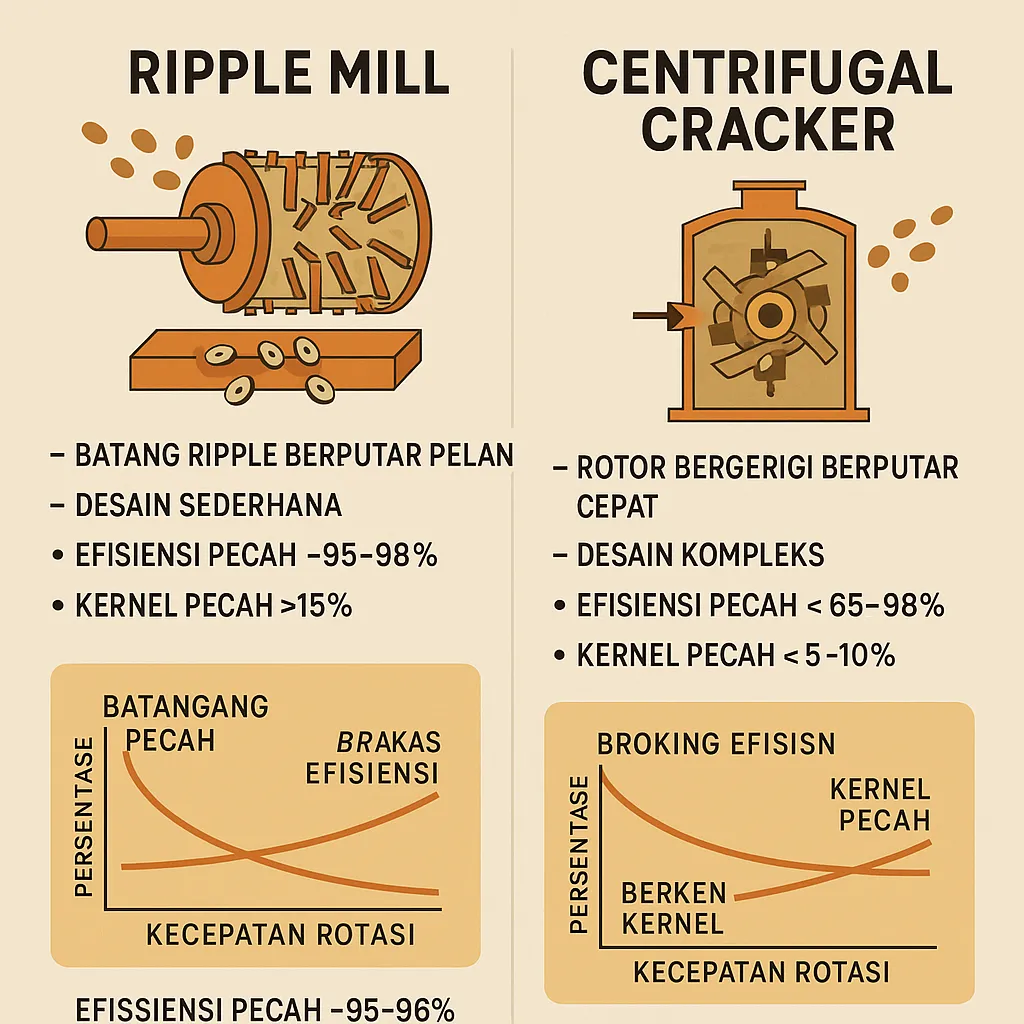
Ripple mills use slowly rotating steel rods or “ripple plates” to crush nuts. Vertical-shaft crackers throw nuts against a hard concave at high speed. Ripple crushers are valued for simple construction and robustness. A modern double-ripple design can run wet nuts directly. It uses a symmetrical rotor with about 40 steel bars for even crushing (Laju) (Laju). Centrifugal crackers need a cooling silo (air duct) and higher-speed drives.
Nut cracker designs and operating principles
Ripple mills came from grain milling and run at low speed. They were never designed for palm nuts. The vertical-shaft cracker was developed for oil palm kernels. A motor spins a toothed rotor or hammers at high RPM (revolutions per minute) inside a stationary casing to shatter the nuts. Ripple rotors usually run at ~600–700 rpm with a large moment of inertia. Centrifugal machines usually run >1,000 rpm.
Construction differs too. Ripple rotors have simpler geometry, with “38–40 steel rods” welded to the drum. Therefore they are relatively easy and inexpensive to maintain (Laju). Centrifugal machines use more bearings and sometimes replaceable plates in the concave. Therefore maintenance is more involved, but it is geared toward consistent high-speed operation.
Cracking efficiency and kernel breakage metrics
Two measures matter most. The first is cracking efficiency, the share of nuts completely cracked into shell and free kernel. The second is kernel breakage ratio, the share of kernels broken into small pieces. In practice, centrifugal crackers tend to give a higher proportion of free kernels and fewer fines than ripple mills. A performance study of a vertical-shaft cracker running at 1,650 rev/min (feed 880 kg/h) found only about 65% of nuts were completely cracked (efficiency <65%). Efficiency rose with speed (Agriculture Journals – RAE).
By contrast, makers of ripple crushers say cracking efficiency is about 95–98%. One Indonesian maker reports its new “double ripple” mill reaches about 98% cracking efficiency. It rescues most half-cracked nuts that would otherwise be lost (Laju) (Laju). In other words, almost all large nuts can be broken into kernel plus shell in one pass. Conditions matter, though. Small, thin-shelled nuts tend to shatter or pass through. Larger nuts crack fully. In a field test on a small ripple mill, “efficiency” ranged only about 27–69% depending on nut size. Therefore ripple performance falls on small nuts.
Kernel breakage is equally important. In the cited centrifugal-cracker study, kernel breakage ratio varied from about 0% up to 18% of the kernels, depending on feed rate and moisture (Agriculture Journals – RAE). Industry experience suggests ripple mills usually produce several times more broken fines. Anecdotal guidelines note ripple mills usually yield »10% broken kernel (due to elastic shell behavior), but well-controlled centrifugal cracking keeps broken material below about 5%. MPOB notes that with proper heating and a centrifugal cracker, broken-kernel losses “seldom exceed 5%”, versus >15% with a ripple mill.
Throughput, conditioning, and usage
Centrifugal crackers are usually used in large mills because they can handle high feed rates (for example 10–20 t/hr) once kernels are pre‑dried to ~6–8% moisture. Ripple mills work well with very wet nuts straight from the sterilizers (sometimes without a nut‑drying silo). One double‑ripple unit is built for high capacity: a 12 t/hr double‑ripple cracker whose blower‑heating array allows feeding unstored nuts. Therefore it saves the energy cost of nut‑drying (Laju) (Laju).
In operation, a centrifugal cracker can clog if the kernels are too hot and the shells stay elastic. Therefore mills always cool the nuts on a nut-silo air deck before cracking. MPOB engineers warn that without a “silo heater” ripple cracking will overheat badly. A centrifugal cracker needs properly cooled nuts, otherwise the kernels deform plastically (MPOB brief on Scribd). In practice, operators choose ripple mills when kernel-drying infrastructure is limited, at some cost in quality. They use centrifugal crackers when a high recovery of intact kernels matters most.
Maintenance regimes and downtime economics
Good upkeep keeps the crushing geometry correct and prevents efficiency losses. That means regular inspection, cleaning and lubrication. Industry data show poor maintenance is a leading cause of downtime: about 40–50% of mill interruptions are linked to equipment failure from inadequate upkeep (palmoilpresses.com). An unscheduled nut-cracker breakdown in peak season can stall production for 12–24 hours. At a lost throughput of 3,000 kg of oil per hour, that adds up quickly (palmoilpresses.com).
A disciplined maintenance regime pays back. Implementing daily/weekly checks (bearing lubrication, belt tension, vibration monitoring, etc.) can reduce unexpected failures by ~60% and cut energy use by ~12% (palmoilpresses.com). Daily and weekly tasks are recommended at the nut‑cracking station—“lubricate critical components, verify oil levels, inspect drive belts and bearings” each day (palmoilpresses.com).
Worn ripple bars or damaged concave liners should be replaced immediately. Clearing shell fragments and polishing deposits prevents jamming. Ripple mills are explicitly noted as “very prone to wear” from lodged fragments. Therefore routine clearing and rod replacement are important. Mills using centrifugal crackers should follow the vendor’s maintenance schedule (including replacement of impact blades or anvil plates) to avoid efficiency drifts.
Good maintenance shows up in better recovery. A Malaysian mill under an OEM performance agreement reported cutting its normal oil‑loss rate roughly in half (from ~0.8–1.0% down to ~0.25–0.5%) simply by using proper parts and service (Alfa Laval). In kernel recovery terms, that means more oil stays with the pressed cake rather than leaking out in the malfunctioning stage. A few percent drop in cracking performance can easily translate into tonnes of lost kernels per day.
Comparative summary and operating context
In practice, palm kernel‑equipping relies on either ripple‑type crushers or centrifugal nut crackers. Ripple mills are rugged and simple (even allowing wet nuts in), but usually generate more fines and need shell‑heating management. Centrifugal crackers are engineered for kernels and usually give higher recovery of whole kernels (with <5–10% broken kernels) (Agriculture Journals – RAE). Ripple designs can approach similarly high efficiency (up to ~98% cracked) (Laju) but still demand careful nut conditioning.
Above all, both machines must be meticulously maintained: studies show that a proactive maintenance program can slash breakdowns ~60% (palmoilpresses.com) and halve normal oil losses (Alfa Laval), directly boosting overall kernel‑cracking efficiency and mill throughput.