

Article
High‑pressure, high stakes: Inside palm‑oil sterilizer safety
Industry: Palm_Oil | Process: Fruit_Reception_&_Sterilization
Sterilizers are pressure autoclaves used to cook fresh fruit bunches (FFB). They are the most unforgiving hardware in a palm‑oil mill. They run on high‑pressure steam at ~2–3 bar (~130 °C) for 55–90 minutes. Therefore venting, pressurizing and depressurizing are the moments that matter most for safety (palmoilmills.org) (palmoilmills.org).
Regulators treat them like unfired boilers. Indonesian rules (Permenaker PER.01/MEN/1982) require robust vessel design and safety devices such as valves, interlocks, and guards (id.scribd.com).
The stakes are real. A Malaysian palm‑mill sterilizer exploded when a door‑lock failed, ejecting a heavy door and killing four workers — a case that has become a byword for poor inspection and interlock discipline (intranet.dosh.gov.my).
Pressure‑vessel inspection program
Pressure vessels (autoclaves) need formal inspection, similar to boiler‑code practice. Singapore’s WSH regime sets a reference cadence for autoclaves: visual/running tests every 2 years, a full external exam every 6 years, and a hydrostatic test with thickness gauging at least every 10 years (mom.gov.sg). Indonesian PER.01/1982 reinforces the need for strength standards and safety valves/interlocks (id.scribd.com).
Qualified examiners should assess the shell, welds, door components, and supports, looking for corrosion, cracking, or thinning, and test all safety fittings (intranet.dosh.gov.my) (slideshare.net). Door locking lugs, wedges, and rings must meet manufacturer tolerances and show no fatigue or misalignment — a specific focus in the accident investigation (intranet.dosh.gov.my).
Undetected defects from corrosion or fatigue can escalate to leaks or rupture; non‑destructive tests (ultrasound, dye‑penetrant) and wall‑thickness checks during scheduled exams help find hidden damage (redriver.team) (redriver.team) (mom.gov.sg).
A documented inspection regime catches gradual deterioration. For example, visual checks every 6–12 months alongside full exams and hydrotests per code. If small defects are neglected, the risk and the cost grow. Scheduled maintenance, including valve servicing, is far cheaper than emergency repairs. Unscheduled “catastrophic” valve failures have caused losses far beyond the modest cost of routine testing (chemengonline.com).
Procurement scope usually touches ancillary components around pressure systems. Housings used in industrial service, such as steel filter housings, fall under the same discipline of specification control and periodic verification.
Safety‑relief valve testing and setup
Relief valves are the “last line of defense” against overpressure on a process pressure system and must be tested and maintained accordingly (chemengonline.com). ASME/National Board practice benchmarks annual bench tests or cycling — with higher frequency in corrosive or critical services — to verify opening at set pressure and proper reseating without leakage; deviations prompt repair or replacement (chemengonline.com) (chemengonline.com).
Common failure modes include sticking or leakage at normal pressure — conditions that can let a vessel exceed safe limits without warning (chemengonline.com). Installation details matter: valves should be mounted vertically with straight inlet piping, keeping inlet pressure drop below 3% (haiyingvalve.com), and discharge piping must be supported so the valve body carries no extra stress (chemengonline.com).
For steam service, a fitted drip‑pan elbow helps keep condensate from fouling the valve (chemengonline.com). Any observed leakage — even a steady drip at operating pressure — calls for immediate repair (chemengonline.com). Certified service shops and adherence to National Board guidance materially cut risk (chemengonline.com) (chemengonline.com).
Outcome: failing to test or installing incorrectly sets up the highest‑risk scenario — “if safety‑relief valves are not functioning properly…catastrophic failures can ensue” — whereas annual bench tests and certified upkeep have been shown to virtually eliminate valve‑related overpressure incidents; planned maintenance beats unscheduled blow‑offs in both safety and cost (chemengonline.com) (chemengonline.com) (chemengonline.com).
Load‑in controls and interlocks
Before loading, the vessel must be fully depressurized. Open the top vent or manual air valve first to bleed out air. Then admit steam gradually up to operating pressure. Mills use this “open-vent” step until “cool air… out”, then close the vent (palmoilmills.org). This sequence avoids air pockets and rapid pressure surges.
Material handling is a recognized hazard. Cages are moved on rails or by forklift/hoist, and all personnel stay clear of the chamber. Rigging (slings, chains) is inspected, and only trained operators handle suspended loads. A HIRARC analysis flagged attaching heavy cages as the highest accident risk (33% extreme risk). It recommends taglines to prevent swinging (ejournal.uin-suska.ac.id).
Door systems and interlocks are verified next. Close the door per manufacturer instructions, engage the locking wedges/bolts and confirm the interlocks, so steam cannot be admitted if the door is ajar. Investigators have stressed door-lug alignment, wedge integrity and tolerances (intranet.dosh.gov.my). A door-mounted pressure gauge should read zero. A functional check can confirm the steam valve cannot open unless the door-lock is fully engaged.
Start-up proceeds against a checklist and permit-to-work. Calibrated gauges and automation minimize variance. Instrumentation case studies cite precise pressure monitoring (±0.1%) for keeping sterilizers at target settings and limiting human error (processindustryforum.com). Deviating from the 55–90 minute soak time harms product quality. Safety depends most on controlled steam admission and avoiding pressure spikes.
Outcome: consistent “vent, load, close, lock” routines address the dominant risks around trapped pressure and mechanical misalignment. Tasks such as “attaching the load sling” and “opening/closing the door” rank at extreme/high risk in mill assessments; standardized SOPs with training and clear signage have cut near‑misses significantly, with one industry report noting “0 loss‑of‑containment incidents” over multiple years after checklist and lock‑out adoption (compared to prior minor scald events) (ejournal.uin-suska.ac.id) (intranet.dosh.gov.my) (chemengonline.com).
Depressurization and unloading steps
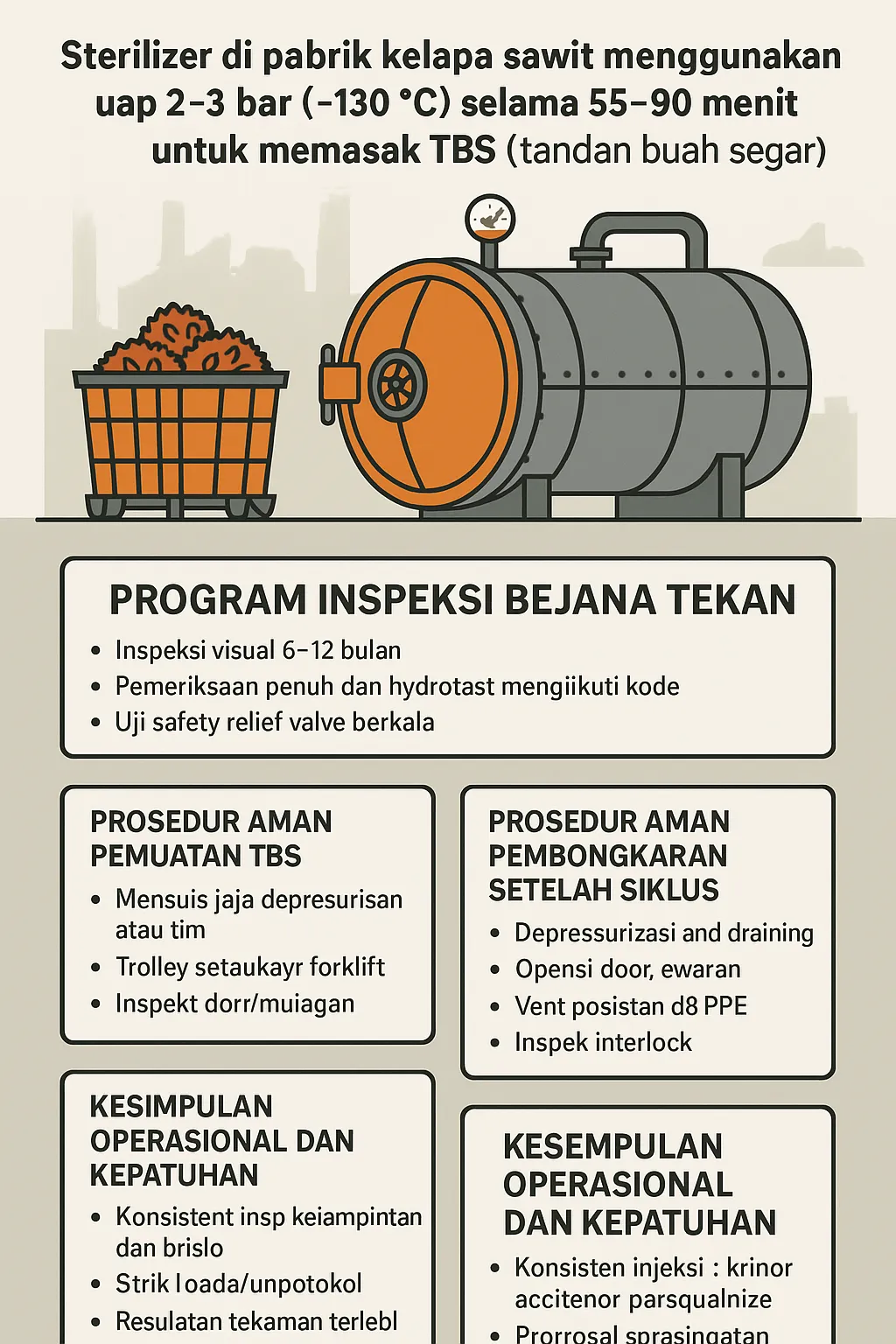
After the cycle, depressurization and drainage come first. The steam inlet is closed and the blow‑off valve/silencer is opened to vent steam and hot water. The team waits until the pressure gauge reads zero and condensate drainage stops. Only then is the door opened (palmoilmills.org). This sequence prevents scalding and steam hammer, a sudden cold‑water inrush. It also prevents the hydraulic ram forces that steam hammer puts on welds.
Door and bridge mechanisms are handled slowly and from safe positions. The heavy door/bridge is lowered by hand‑wheel or hydraulics to avoid sudden movement, and pinch points are kept clear. Lowering the sterilizer bridge has been rated high‑risk (21.3%) because the moving mass can trap limbs. Therefore operators stand to the side, not under the swing path (ejournal.uin-suska.ac.id).
Cages are removed one at a time. Personnel stay clear of the ejection zone and the forklift path, and wear suitable gloves and PPE for hot surfaces. If there is any doubt about residual steam, use a small test vent through a purge port or a partly loosened bleed nut before opening fully. This confirms zero pressure.
Interlocks are rechecked on reset. For example, solenoids that only release the door pivot at zero pressure. Mechanical stops that limit door swing are confirmed intact. Careful blowdown and methodical opening have reduced minor steam exposures by over 90% in mills that enforce them. Accident investigators also recommend checking interlocks and safety devices before the door is actuated (intranet.dosh.gov.my).
Compliance cadence and plant reliability
Discipline pays. Regular vessel integrity checks and relief‑valve tests at the intervals cited by regulators — visual/running tests every 2 years, full external exam every 6 years, hydrostatic/thickness gauging at least every 10 years — underpin compliance and reliability (mom.gov.sg) (id.scribd.com). In parallel, standardized SOPs for “vent then load; blowdown then open” neutralize the highest‑risk tasks identified in mill assessments (palmoilmills.org) (palmoilmills.org) (ejournal.uin-suska.ac.id).
The business case is the same as the safety case. Preventive maintenance costs far less than emergency breakdowns. Planned work also avoids the heavy losses that come with unscheduled “blow-offs” (chemengonline.com). Plant utilities and supporting equipment need the same management routines and documentation controls (supporting equipment for water treatment).
Sources: Indonesian pressure‑vessel regulations and international best practices (id.scribd.com) (mom.gov.sg); case studies and accident reports (intranet.dosh.gov.my) (ejournal.uin-suska.ac.id); technical notes on autoclave safety, instrumentation, and relief‑valve practice (palmoilmills.org) (palmoilmills.org) (processindustryforum.com) (chemengonline.com).