

Article
Hard water is a hard stop for pulp mills Ion‑exchange softening is the fix that sticks
Industry: Pulp_and_Paper | Process: Raw_Water_Intake_&_Treatment
Globally, pulp and paper consumes on the order of 90–100 million m³ of water per day for wood prep, pulping, bleaching and paper forming, with Asia‑Pacific mills accounting for nearly half of this demand (ResourceWise) (ResourceWise). That scale of throughput makes calcium and magnesium (hardness ions) a perennial headache: they precipitate as carbonate, phosphate or oxalate scales on heat exchangers, boilers, pipes and paper‑machine showers—driving shutdowns, plugging and higher energy and chemical use (WaterTechOnline).
This is not an abstract risk. Scale buildup in disc filters or shower lines usually forces cleaning every few months (WaterTechOnline). If nothing is done, hard water raises operating costs and downtime a lot in P&P mills.
Hardness removal by sodium‑cycle ion exchange
A conventional water softener uses a fixed‑bed ion‑exchange process. It swaps hardness cations (Ca²⁺, Mg²⁺) for sodium (Na⁺) on a resin. Mills usually use a strong‑acid cation (SAC) resin, sulfonated polystyrene‑divinylbenzene, in the sodium form. Raw water flows downward. Ca²⁺ and Mg²⁺ bind to exchange sites and Na⁺ is released. Veolia puts it simply: in a sodium zeolite softener, scale‑forming Ca²⁺/Mg²⁺ are replaced with Na⁺ (Veolia Water Technologies Handbook). The exchange reactions are:
Ca(HCO₃)₂ + 2 Na–R → Ca–R₂ + 2 NaHCO₃ MgCl₂ + 2 Na–R → Mg–R₂ + 2 NaCl
R–Na is a resin bead with mobile Na⁺. The outgoing “soft” water contains almost no Ca²⁺/Mg²⁺ (ideally ≪1 mg/L hardness), so it forms much less scale (Veolia Water Technologies Handbook). Ion‑exchange softening does not change pH or alkalinity much. However, it raises total dissolved solids (TDS) because divalent ions are replaced with monovalent sodium (MECC Water).
In service, a softener gives low hardness until breakthrough. At breakthrough, effluent hardness rises sharply as the resin nears exhaustion. Figure 8‑5 of Veolia’s handbook (not shown) shows that effluent hardness stays near zero until this point. After that, regeneration is needed (Veolia Water Technologies Handbook).
Regeneration pushes a concentrated brine (approximately 10–15% NaCl) upward through the bed to displace Ca²⁺/Mg²⁺ and recharge sites with Na⁺ (reaction: Ca–R₂ + 2 NaCl → 2 Na–R + CaCl₂) (Veolia Water Technologies Handbook). About three times the stoichiometric Na⁺ is typically applied, so a large excess of salt—on the order of 6–12 lb NaCl per ft³ of resin—is used (Veolia Water Technologies Handbook) (SystematixUSA).
The equipment is straightforward. A vertical‑pressure resin vessel holds top distributors, a resin bed and an underdrain. A brine tank, piping and a control valve sequence the backwash, brine and rinse steps (Veolia Water Technologies Handbook) (Veolia Water Technologies Handbook). In operation, the bed is backwashed first to lift the media and remove suspended solids. Then it is soaked and rinsed with brine. Modern systems usually use programmable controls and automatic lead/standby switching so the output does not stop. Where plants specify the equipment class, a softening system falls broadly under ion‑exchange systems and uses ion‑exchange resins. Brine tanks, valves and piping are typical supporting equipment.
Sizing, capacity and regeneration scheduling
Proper sizing matters. Softener capacity is rated in grains of hardness removed as CaCO₃ per volume of resin (1 grain per gallon, gpg, is a common field unit; gpg is a measure of hardness). Typical SAC resins have capacities on the order of 20,000–30,000 grains per cubic foot when regenerated fully (Veolia Water Technologies Handbook) (SystematixUSA). Veolia reports that adding about 10 lb NaCl per ft³ yields roughly 24,000 grains/ft³ capacity (Veolia Water Technologies Handbook). In practical terms, one cubic foot of resin may treat roughly 2,000–3,000 gallons of 10–12 gpg water (about 170–200 mg/L hardness) between regenerations (SystematixUSA).
The sizing math starts with total hardness load (flow × hardness). For example, a 25 gpm line (≈5.7 m³/h) at 200 mg/L as CaCO₃ (≈12 gpg) carries about 18,000 grains per hour. To run 8 hours without regeneration, the load is ≈144,000 grains. At ~22,000 grains/ft³ capacity, the project would need ≈6.5 ft³ (~0.18 m³) of resin (SystematixUSA). Designers usually target a run length (for example 6–10 hours) or meter‑based regeneration that triggers just before breakthrough. Some capacity margin is prudent. Oversizing or paralleling vessels lowers the risk of any hard‑water leakage between cycles.
Regeneration intervals and salt use vary with load. A common design rule is to regenerate no more often than every 3–4 days and no less often than about 1–2 weeks (for domestic systems; industrial practice scales similarly). Typical salt dosage is 6–10 lb (2.7–4.5 kg) NaCl per ft³ of resin per cycle to achieve roughly 20–25 kgrains/ft³ capacity (Veolia Water Technologies Handbook) (Watts). Watts notes that 6–8 lb/ft³ yields about 24,000‑grain performance (Watts). For example, a 1 ft³ bed (about 28 L resin) with 8 lb salt will remove about 21,000 grains (≈1.2 kg CaCO₃) (SystematixUSA). Industrial softeners may have dozens of cubic feet of resin. Therefore they use hundreds of kilograms of salt per cycle.
Regeneration also uses water. Backwash and rinse flows are usually 5–10 times the resin bed volume. SystematixUSA notes that regenerating a 1 ft³ bed uses about 50 gallons (≈190 L, roughly 7× resin volume) (SystematixUSA). The brine and hardness salts (CaCl₂, MgCl₂) are flushed as waste. In large mills, some recovery is possible by returning them to clarifiers or process if acceptable.
To keep running without a stop, mills usually use at least two vessels in parallel. One is in service while the other regenerates, then they swap. Automatic alternating or multistep parallel setups prevent interruption or leakage. Online hardness monitors (or timers/metering) trigger regeneration before breakthrough. Point‑of‑entry softeners may also serve several circuits (boiler feed, shower water, etc.) with parallel trains sized per flow. Good sizing and regeneration scheduling are important. If a bed is too small or regenerations too infrequent, hardness will break through and cause scale. Oversizing can waste salt and water. Good design targets a desired run length, for example 5–7 days of service per cycle. It uses metered valves or PLC control to regenerate only when capacity is truly used up. This keeps salt usage low and gives a consistent soft‑water supply (Watts) (SystematixUSA).
Softening versus chemical scale inhibitors
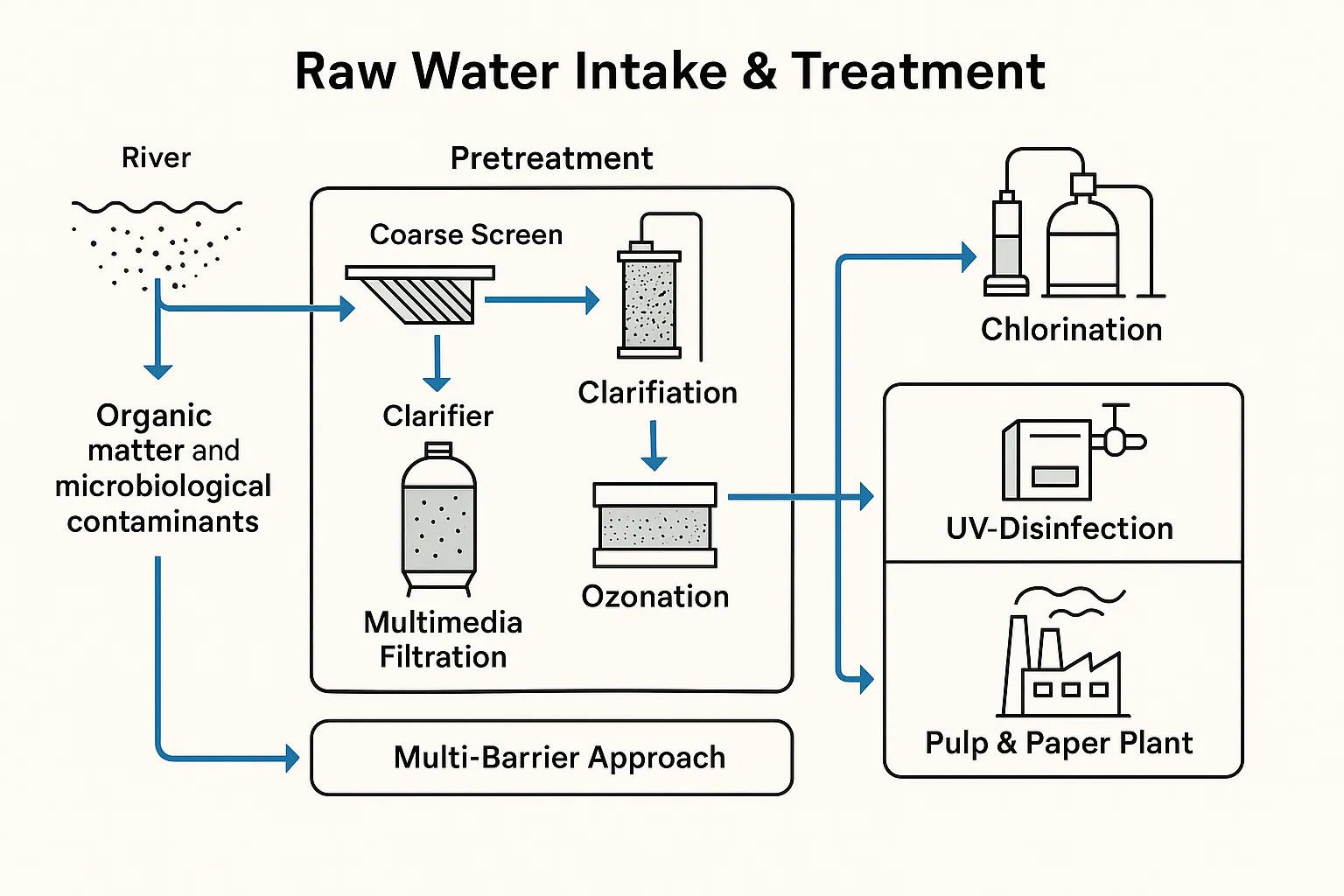
Ion‑exchange softening produces very consistent water with very low hardness. After regeneration, a properly designed system usually delivers water with hardness below detection limits, usually less than 1 mg/L as CaCO₃ (Veolia Water Technologies Handbook). The trade‑off is operating cost: salt usage (dozens of tons per month on large plants) and brine disposal are inevitable. Salt consumption can run on the order of tens of kilograms per cubic meter of softened water (depending on hardness). For example, a plant treating 1000 m³/day at 200 mg/L hardness (≈6 moles CaCO₃) would need roughly 600–1200 kg of salt per day (using ~6–12 kg salt per m³ as a rule‑of‑thumb).
Many facilities use chemical scale inhibitor programs instead of softening, or alongside it. Common agents include sodium phosphates, phosphonates and polymeric dispersants. They interfere with scale formation by sequestration, precipitation or dispersion. Such programs are popular for cooling towers and boilers at moderate pressure because they need only a dosing skid, which means lower capex. In practical terms, that means a dosing pump feeding a scale inhibitor into the circuit. However, there are limits. ChemTreat notes that phosphate treatment programs precipitate hardness as calcium phosphate (hydroxyapatite) and serpentinite. These solids must be removed by boiler blowdown or blow‑off to avoid buildup. Even well‑fed phosphate only mitigates scale, and residual solids inevitably accumulate on tube surfaces (ChemTreat). All‑polymer treatments can sequester some hardness, but they are usually feasible only in low‑ to intermediate‑pressure boilers (ChemTreat).
Industry guidelines need very low feedwater hardness. The ASME boiler code limits acceptable hardness to the sub‑ppm range (≪0.1 mg/L as CaCO₃) for high‑pressure boilers. ChemTreat warns that if feed hardness is above about 1.0 ppm, phosphate programs alone are not enough (ChemTreat). In short, if boiler feed has significant hardness (>0.5–1 mg/L), softening usually deals with it, not chemistry. Even in a chemical program, softeners usually come before injection.
Pulp mills with high‑pressure steam systems and high downtime costs take the conservative approach. They use softening for makeup water to important units and add chemical boosters where feasible. Phosphate or polymer programs can only tolerate limited hardness, and they usually add phosphorus load to effluent. A softener replaces Ca/Mg with Na and has no effluent phosphorus impact. In practice, many large mills use both: softeners for the hardest service requirements, plus small inhibitor doses for redundancy and localized scale prevention. Chemical programs remain important. However, conventional ion‑exchange softening gives the best protection against scale in pulp and paper operations. Real‑world outcomes reflect this. Boilers with softened makeup usually achieve longer runs and higher heat‑transfer efficiency. Boilers treated only with inhibitors usually have routine deposits, managed with frequent blowdown and cleaning (ChemTreat) (ChemTreat).
Operational outcomes and trendlines
- Water savings and recycling: Good softening makes reuse easier. Softened water, or RO permeate downstream of softening, can be recirculated through many mill systems. Industry reports note that Asia‑Pacific pulp mills (including Indonesian producers) now reuse water many times as a routine. Sappi and others report up to 7–10 cycles of internal water reuse, with softening/RO to polish boiler feed (ResourceWise). In projects that use RO permeate for polish, mills usually look at brackish-water RO as part of the reclaim train.
- Reduced maintenance: Plants that upgrade from partial chemical treatment to full softening usually see measurable drops in maintenance. Case studies in related industries show 20–50% reductions in boiler cleaning frequency when hardness is fully removed. That translates to several percentage points of thermal efficiency gain. Published data for pulp mills are scarce. However, similar benefits can be inferred: lower fuel use per ton of steam, fewer unplanned outages, and longer tube life.
- Chemical and salt usage: Softening incurs ongoing salt expense. A mid‑size mill with 10 mgd softening may use 5–10 tons of salt per day (≈60–120 kg/day per 100 m³/h flow at 200 mg/L hardness). By contrast, a chemical program might use only tens of kg/day of dosing chemicals. However, it needs larger blowdown volumes, which usually raise effluent TDS/COD loads. Lifecycle analyses usually find that softeners give the lowest total cost for high‑hardness sources, because boiler efficiency is better and downtime is less.
- Regulatory aspects: In Indonesia, environmental regulations (Permen KLHK standards) focus on effluent quality (BOD, COD, TSS, nutrients), not on hardness itself. Those standards are easier to meet when cooling and process waters are treated, because too much hardness can increase blowdown and waste streams. National water scarcity policies, such as limits on groundwater use that implement approval requirements (World Water Forum), give mills an incentive to optimize raw water use. Therefore they encourage closed‑loop systems with proper softening.
Design anchors and reference data
Key parameters from industry references anchor the design space: softener capacities on the order of 20,000–30,000 grains/ft³; common salt dosages of 6–10 lb/ft³ per regeneration (Watts notes 6–8 lb/ft³ yields about 24,000 grains); brine concentration around 10–15% NaCl; example flow/hardness loads such as 25 gpm at 200 mg/L (12 gpg) equating to ~18,000 grains/hour; and rinse water of roughly 5–10× bed volume, about 50 gallons per 1 ft³ bed (~190 L) (Veolia Water Technologies Handbook) (Veolia Water Technologies Handbook) (Veolia Water Technologies Handbook) (Veolia Water Technologies Handbook) (SystematixUSA) (Watts) (MECC Water).
Sources: Authoritative industry and technical references (Water Technology, chemical treatment suppliers, water treatment handbooks) and market data were used to quantify water use, resin capacities and treatment performance (ResourceWise) (WaterTechOnline) (Veolia Water Technologies Handbook) (Veolia Water Technologies Handbook) (Veolia Water Technologies Handbook) (SystematixUSA) (ChemTreat) (ChemTreat). These provide the basis for the figures and recommendations above.